


Stripe Review 2026: Is It the Right Payment Platform for Your Business?
Stripe Review 2026: Features, Fees, Pros & Cons Explained? Choosing the right payment processor is an important decision for any business. Whether you run an online store, SaaS company, marketplace, or freelance business, you need a platform that makes accepting payments simple, secure, and reliable.
Stripe has become one of the most popular payment processors worldwide. It supports millions of businesses, from startups to global enterprises. However, popularity does not always mean it is the best option for every business.
In this Stripe Review 2026, we’ll explore its features, pricing, advantages, disadvantages, and who should consider using it. We’ll also compare its strengths with other payment providers to help you make an informed decision.
What Is Stripe?
Stripe is a global online payment platform founded in 2010. It allows businesses to accept online payments, manage subscriptions, send invoices, process in-person transactions, and automate financial workflows from one platform.
Unlike many traditional payment processors, Stripe was built with developers in mind. Its powerful APIs make it easy to build custom payment experiences. At the same time, businesses with little or no coding experience can use ready-made checkout pages, payment links, and no-code tools.
Today, Stripe serves businesses in many industries, including:
- Ecommerce stores
- SaaS companies
- Digital agencies
- Online marketplaces
- Subscription businesses
- Mobile app developers
- Content creators
- Enterprise organizations
Because of its flexibility, Stripe works well for both small businesses and large companies.
Quick Overview
Pros
Stripe offers several advantages that make it one of the leading payment platforms.
- Simple pay-as-you-go pricing
- No monthly subscription fees for standard accounts
- Supports many currencies and payment methods
- Excellent developer tools and APIs
- Fast and secure checkout experience
- Easy integration with thousands of business applications
- Scales as your business grows
Cons
Despite its strengths, Stripe also has some limitations.
- Processing fees can be higher than some competitors.
- Account reviews may temporarily delay payouts.
- High-risk businesses may not qualify.
- Customer support experiences are inconsistent.
- Some advanced features require technical knowledge.
Understanding these strengths and weaknesses helps you decide whether Stripe matches your business needs.
The Story Behind Stripe
Stripe was founded in 2010 by Irish brothers John and Patrick Collison. While studying in the United States, they noticed that accepting online payments was often difficult, especially for developers.
They created Stripe to solve this problem by offering an easy-to-use payment platform with a simple API. Their goal was to reduce the time and effort needed to add payment processing to websites and applications.
The idea quickly gained attention. Early investment from Y Combinator and several well-known technology investors helped Stripe expand rapidly.
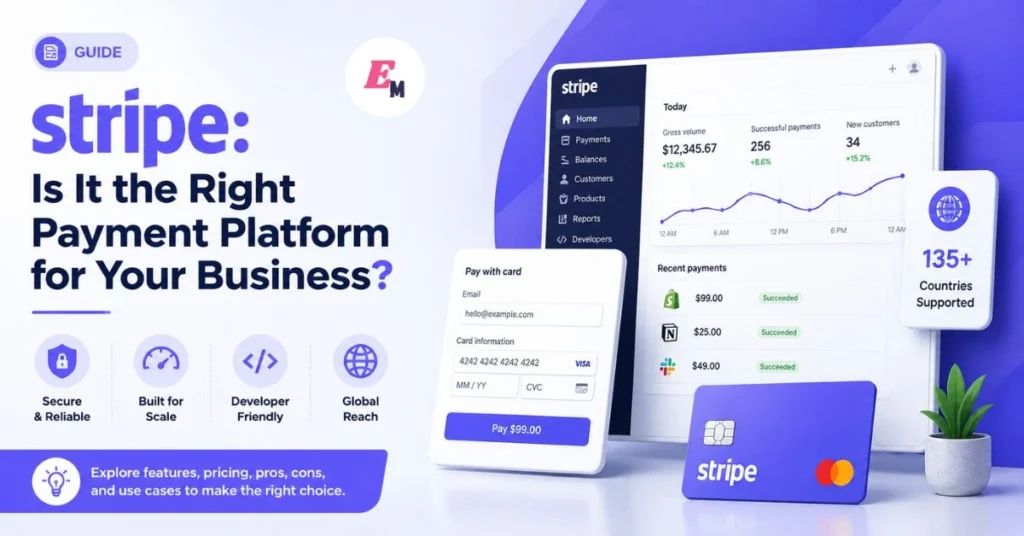
Since then, Stripe has introduced many new products, including subscription billing, fraud prevention, financial reporting, business financing, and in-person payment solutions. It also continues to expand into new countries and supports businesses of all sizes.
Today, Stripe processes billions of dollars in payments every year and remains one of the most trusted payment platforms in the world.
Why Stripe Is Popular
Many businesses choose Stripe because it combines ease of use with powerful customization.
A startup can begin accepting payments within minutes using Stripe’s hosted checkout page. Later, as the business grows, developers can build fully customized payment experiences without changing providers.
This flexibility makes Stripe attractive for businesses that expect to scale over time.
Other reasons for Stripe’s popularity include:
- Support for international payments
- Built-in fraud protection
- Subscription billing tools
- Payment links
- Mobile payment options
- Marketplace payment solutions
- Extensive third-party integrations
Instead of using several separate tools, many businesses manage their payment operations from one dashboard.
Stripe for Startups and Small Businesses
Stripe is especially appealing to startups because getting started is simple.
Businesses can create an account, connect their bank, and begin accepting payments without paying setup fees or signing long-term contracts.
The platform provides ready-made payment pages, invoices, payment links, and subscription tools that require little or no coding.
For example, a freelance designer can send payment links directly to clients by email. Likewise, an online store can integrate Stripe with popular ecommerce platforms and begin accepting card payments within a few hours.
As business grows, Stripe allows owners to add advanced features such as recurring billing, automated tax collection, financial reporting, and custom payment flows.
This means companies can continue using the same platform instead of switching to another provider later.
Stripe for Large Businesses
Stripe also offers enterprise-level solutions for businesses with complex payment needs.
Large organizations can build fully customized payment systems using Stripe’s APIs. They can automate accounting processes, integrate enterprise software, create customer portals, and manage global payments from a single platform.
Businesses with high transaction volumes may also qualify for custom pricing, making Stripe more cost-effective as payment volume increases.
For companies operating in multiple countries, Stripe supports local payment methods, multiple currencies, and regional payment preferences, helping improve customer experience and increase conversion rates.
Is Stripe Easy to Use?
One reason Stripe continues to grow is its balance between simplicity and flexibility.
Business owners without technical experience can use built-in tools to accept payments almost immediately.
Developers, meanwhile, gain access to powerful APIs that allow complete control over the checkout process and payment workflows.
This combination makes Stripe suitable for a wide range of businesses, from solo entrepreneurs to multinational companies.
Stripe Payment Features: Everything You Need to Know
Stripe offers much more than basic payment processing. It gives businesses several ways to accept payments online, in person, and through subscriptions. Whether you run a small online shop or a global business, Stripe provides flexible tools that grow with your needs.
Let’s look at its main payment features.
Online Payment Processing
Stripe makes it easy to accept payments through websites, mobile apps, and online stores. Businesses can accept debit cards, credit cards, digital wallets, bank transfers, and many local payment methods from customers worldwide.
The platform also handles payment security, fraud prevention, encryption, and compliance with industry standards. As a result, business owners can focus on growing their companies instead of managing payment infrastructure.
Another advantage is Stripe’s fast integration. Most popular ecommerce platforms, such as Shopify, WooCommerce, Adobe Commerce, and custom-built websites, support Stripe with little or no development work.
Embedded Checkout vs. Stripe Hosted Checkout
Stripe offers two primary checkout options. Each serves different business needs.
Embedded Checkout
Embedded Checkout allows you to place the payment form directly on your website.
Customers stay on your site throughout the payment process, creating a more consistent brand experience. You can also customize the layout, colors, fonts, and user interface to match your website.
This option works well for businesses that want complete control over their checkout experience.
Stripe Hosted Checkout
Hosted Checkout redirects customers to a secure Stripe payment page.
Although customers briefly leave your website, Stripe manages the entire payment process, including security updates, compliance, payment methods, tax calculations, and mobile optimization.
This option is ideal for startups and small businesses because it requires very little technical knowledge.
Which Checkout Option Is Better?
The right choice depends on your business goals.
Choose Embedded Checkout if you:
- Want full branding control
- Have development resources
- Need a customized checkout experience
Choose Hosted Checkout if you:
- Want the fastest setup
- Prefer lower maintenance
- Need enterprise-level security without extra work
Both options support one-time purchases, subscriptions, discounts, promotional codes, and multiple payment methods.
Stripe Billing for Recurring Payments
Subscription businesses need more than simple payment processing. They need billing automation.
Stripe Billing is designed for businesses that charge customers on a recurring basis.
It helps manage:
- Monthly subscriptions
- Annual memberships
- Software licenses
- Service contracts
- Digital products
- Online courses
Instead of manually creating invoices every month, Stripe automatically bills customers according to the subscription schedule.
This saves time and reduces administrative work.
Flexible Subscription Models
One of Stripe’s biggest strengths is its flexible subscription system.
Businesses can create different pricing structures, including:
- Monthly plans
- Annual plans
- Free trials
- Tiered pricing
- Pay-per-user pricing
- Usage-based billing
- Flat-rate subscriptions
For example, a SaaS company can offer Basic, Pro, and Enterprise plans while allowing customers to upgrade or downgrade at any time.
This flexibility makes Stripe suitable for growing subscription-based businesses.
Smart Billing Automation
Stripe Billing includes several automation features that improve payment collection.
These include:
- Automatic invoice generation
- Payment reminders
- Smart payment retries
- Failed payment recovery
- Customer billing portal
- Tax calculation
- Coupon and discount management
These tools help reduce failed payments and improve customer retention without requiring additional software.
Payment Links
Not every business has a website.
For freelancers, consultants, agencies, and small service providers, Stripe Payment Links provide a simple way to collect payments.
Businesses can create a secure payment link within minutes and send it through:
- SMS
- Facebook Messenger
- Instagram Direct Messages
- QR codes
Customers simply click the link, enter their payment details, and complete the transaction securely.
For example, a graphic designer can finish a project and immediately send a payment link to the client without creating an online store.
This feature is especially useful for businesses that invoice customers manually.
Stripe Invoicing
Stripe also includes professional invoicing tools.
Businesses can create branded invoices, send them electronically, and allow customers to pay online using multiple payment methods.
Invoices can include:
- Company branding
- Payment due dates
- Taxes
- Discounts
- Product details
- Custom notes
Since payments are automatically tracked, accounting becomes much easier.
Stripe Terminal for In-Person Payments
Stripe is not limited to online businesses.
With Stripe Terminal, businesses can also accept face-to-face payments.
This makes Stripe suitable for:
- Retail stores
- Restaurants
- Pop-up shops
- Events
- Service providers
- Local businesses
Stripe Terminal supports secure card readers and contactless payment devices that connect directly with your Stripe account.
As a result, online and offline sales appear in one dashboard.
Contactless and Mobile Payments
Stripe Terminal supports several modern payment methods.
Customers can pay using:
- Debit cards
- Credit cards
- Contactless cards
- Apple Pay
- Google Pay
- Mobile wallets
- NFC-enabled smartphones
Some businesses can even accept contactless payments directly on compatible smartphones without purchasing separate hardware.
This reduces setup costs while improving customer convenience.
Global Payment Methods
Modern customers expect multiple payment options.
Stripe supports a wide range of payment methods worldwide, helping businesses increase conversion rates and reduce cart abandonment.
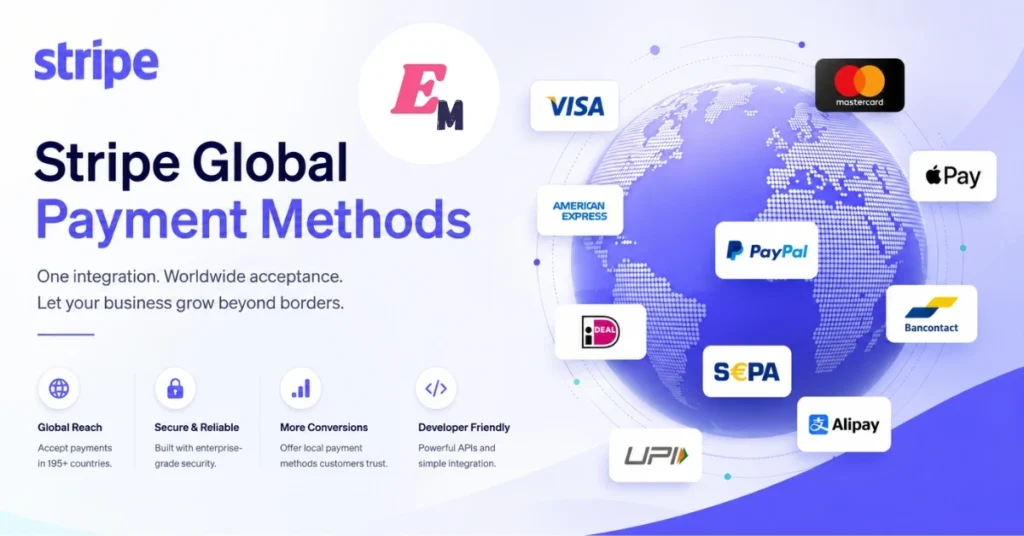
Depending on the customer’s country, Stripe can accept:
- Visa
- Mastercard
- American Express
- Discover
- Apple Pay
- Google Pay
- Bank transfers
- ACH payments
- SEPA Direct Debit
- Buy Now, Pay Later services
- Local payment methods
Offering familiar payment options builds trust and encourages customers to complete their purchases.
Multi-Currency Support
Stripe is designed for international businesses.
It supports payments in more than 135 currencies, allowing customers to pay in their local currency while businesses receive funds according to their account settings.
This feature is particularly valuable for:
- Ecommerce businesses
- SaaS companies
- Online marketplaces
- Export businesses
- Digital agencies
- Global freelancers
Accepting local currencies can improve the shopping experience and reduce abandoned checkouts.
Security and Fraud Protection
Security is one of Stripe’s strongest features.
Every transaction is protected using advanced encryption and industry-standard security protocols.
Stripe also includes fraud prevention tools that use machine learning to detect suspicious activity before payments are completed.
Additional security features include:
- PCI DSS compliance
- Tokenized card information
- 3D Secure authentication
- Real-time fraud monitoring
- Risk scoring
- Dispute management
These features help businesses reduce fraud while protecting customer payment information.
Why These Features Matter
Stripe combines payment processing, subscriptions, invoicing, fraud protection, and global payment support into one platform.
Instead of using several different payment tools, businesses can manage everything from a single dashboard.
This saves time, improves efficiency, and creates a better experience for both business owners and customers.
Stripe Fees and Pricing (2026)
Understanding Stripe’s pricing is essential before choosing it as your payment processor. Although Stripe uses a simple pay-as-you-go pricing model, additional services can increase your overall costs. Therefore, it’s important to know exactly what you’ll pay.
The good news is that Stripe does not charge setup fees, monthly subscription fees for standard accounts, or long-term contract fees. Instead, you pay only when you successfully process a payment.
This pricing structure makes Stripe attractive for startups, freelancers, and small businesses that want to avoid fixed monthly costs.
Standard Online Payment Fees
Stripe charges a fee for every successful transaction. The exact amount depends on the type of card and where the customer is located.
Generally, domestic card payments cost less than international transactions.
For many small businesses, the transparent pricing model makes it easy to estimate monthly payment processing expenses without negotiating custom contracts.
If your business processes a high volume of transactions, you may qualify for custom pricing with lower rates.
Domestic Card Payments
For local card payments, Stripe offers competitive pricing with no hidden monthly charges.
This makes budgeting much easier because you only pay when you receive money.
For example, if you own a small online clothing store, your payment processing costs increase only as your sales grow.
This approach helps businesses control expenses during the early stages.
Read Also: Payoneer Review 2026: Is It Worth It for Freelancers?
International Payment Fees
Selling internationally can help grow your business, but it also increases payment processing costs.
Stripe charges higher fees for cards issued outside your country because international payments involve additional banking networks and currency handling.
Although these fees are common across the payment industry, businesses with many overseas customers should include them in their pricing strategy.
Currency Conversion Charges
Stripe supports more than 135 currencies, making it an excellent choice for international businesses.
However, when payments require currency conversion, an additional conversion fee applies.
For businesses selling globally, this cost can become significant over time.
If most of your customers pay in foreign currencies, compare these charges with other payment providers before making a decision.
Recurring Billing Fees
Businesses using Stripe Billing pay an additional fee for subscription management.
This service automates recurring payments, invoices, free trials, customer billing portals, and subscription changes.
While this adds to your processing costs, many subscription-based businesses find that the automation saves far more time than it costs.
For SaaS companies, membership websites, online learning platforms, and subscription boxes, this feature is often worth the investment.
Payment Links and Online Invoices
Stripe allows businesses to collect payments without building a website.
Payment Links and online invoices make it easy to receive payments through email, messaging apps, or social media.
These tools work especially well for:
- Freelancers
- Consultants
- Digital agencies
- Coaches
- Small service businesses
Since setup takes only a few minutes, businesses can begin accepting payments almost immediately.
In-Person Payment Costs
Businesses using Stripe Terminal can accept payments at physical locations.
Transaction fees for in-person payments are generally lower than online payments because card-present transactions carry less fraud risk.
However, businesses must purchase compatible card readers or use supported mobile payment devices.
Although the hardware requires an upfront investment, many retailers appreciate having both online and offline sales managed in one system.
Additional Stripe Services
Stripe offers many optional products beyond payment processing.
These services can improve business operations, but they also add extra costs.
Some of the most popular add-on services include:
- Advanced subscription billing
- Automated invoicing
- Tax calculation
- Revenue reporting
- Business analytics
- Fraud detection
- Chargeback protection
- Identity verification
- Data reporting tools
Businesses should only enable the services they truly need to keep expenses under control.
Chargebacks and Dispute Fees
Like most payment processors, Stripe charges a fee when customers dispute a payment.
Chargebacks happen when customers ask their bank to reverse a transaction.
Although not every dispute results in lost revenue, businesses should monitor their chargeback rate carefully.
Reducing fraudulent orders, providing clear refund policies, and maintaining excellent customer service can help minimize disputes.
Fraud Protection Tools
Online fraud continues to grow every year.
To help businesses reduce risk, Stripe includes powerful fraud detection features.
Its machine-learning system analyzes payment behavior in real time and identifies suspicious transactions before they are approved.
Businesses can also adjust fraud rules based on their own risk tolerance.
While advanced fraud protection may include additional costs, preventing fraudulent transactions often saves much more money in the long run.
Reporting and Business Analytics
Stripe offers several reporting tools that help businesses understand their financial performance.
Users can access information such as:
- Payment history
- Sales reports
- Customer activity
- Refund reports
- Payout summaries
- Revenue trends
Basic reports are included with every account.
Businesses that need more detailed financial analysis can purchase advanced reporting features.
These reports are particularly useful for finance teams, accountants, and enterprise organizations.
Are There Any Hidden Fees?
Stripe is generally transparent about its pricing.
However, many businesses underestimate the cost of optional services.
Your total monthly expense may increase if you use:
- Subscription billing
- Tax automation
- Fraud protection
- Advanced reporting
- Currency conversion
- Identity verification
- Instant payouts
These features can provide significant value, but they should be included in your overall budget.
Is Stripe Good Value for Money?
For many businesses, the answer is yes.
Stripe offers an impressive combination of payment processing, security, automation, subscriptions, invoicing, and global payment support.
Instead of paying several software providers separately, businesses can manage everything from one platform.
However, businesses processing very large payment volumes should compare Stripe’s pricing with providers that offer custom merchant accounts.
Lower transaction fees from competitors may produce significant savings over time.
Who Gets the Best Value from Stripe?
Stripe offers the greatest value for businesses that need flexibility and room to grow.
It is an excellent choice for:
- Startups
- Ecommerce stores
- SaaS companies
- Subscription businesses
- Online marketplaces
- Digital agencies
- Freelancers
- Software developers
On the other hand, businesses operating in high-risk industries or processing very large monthly payment volumes may find better pricing through specialized payment providers.
Key Takeaways
Stripe’s pricing is simple, transparent, and easy to understand.
The absence of setup fees and monthly contracts makes it accessible to businesses of all sizes. Additionally, its extensive features reduce the need for multiple third-party tools.
However, international payments, currency conversion, subscription billing, and optional services can increase your overall costs. Therefore, always calculate your total monthly expense instead of focusing only on the standard transaction fee.
Stripe Alternatives: How Does Stripe Compare?
Stripe is one of the leading payment processors, but it is not the only option. Depending on your business type, transaction volume, and budget, another provider may offer better pricing or features.
Below is a detailed comparison of Stripe and its biggest competitors to help you choose the right payment solution.
Stripe vs PayPal
Stripe and PayPal are two of the most recognized payment platforms in the world. Both allow businesses to accept online payments quickly, but they serve different types of users.
Stripe Advantages
Stripe is designed for businesses that want flexibility and customization.
It offers:
- Advanced APIs for developers
- Better subscription management
- Custom checkout experiences
- More payment integrations
- Greater automation
- Better scalability
Businesses planning long-term growth often prefer Stripe because it can handle more complex payment workflows.
PayPal Advantages
PayPal focuses on simplicity.
Customers recognize the PayPal brand, which can increase buyer confidence, especially for small online stores.
It is a good option for:
- Freelancers
- Small businesses
- Individuals
- Businesses without technical teams
PayPal also allows customers to pay using their PayPal balance without entering card information.
Which One Should You Choose?
Choose Stripe if you want:
- Better customization
- Subscription billing
- Developer tools
- International business growth
- Scalable payment infrastructure
Choose PayPal if you want:
- Faster setup
- Strong brand recognition
- A familiar checkout experience
- Simple online payments
Winner: Stripe is generally the better choice for growing businesses, while PayPal remains a solid option for beginners.
Stripe vs Square
Square began as a payment solution for physical stores, but it has expanded into ecommerce and online payments.
Although both companies process online payments, they target different audiences.
Stripe Strengths
Stripe excels in:
- Ecommerce
- SaaS businesses
- Subscription services
- Online marketplaces
- International sales
- API customization
Square Strengths
Square is better suited for businesses with physical locations.
Its ecosystem includes:
- POS systems
- Card readers
- Inventory management
- Employee scheduling
- Retail reporting
- Restaurant management tools
Everything works together within one platform.
Which Is Better?
Choose Stripe if most of your revenue comes from online sales.
Choose Square if you primarily sell in a retail store, restaurant, or local business.
Winner: Stripe for online businesses. Square for brick-and-mortar businesses.
Stripe vs Adyen
Adyen is another global payment processor trusted by many large international companies.
Unlike Stripe, Adyen mainly targets medium-sized and enterprise businesses.
Stripe Advantages
Stripe provides:
- Easier setup
- Better documentation
- More beginner-friendly tools
- Faster onboarding
- Excellent developer resources
Small businesses usually find Stripe easier to start with.
Adyen Advantages
Adyen focuses on enterprise payment infrastructure.
Its strengths include:
- Omnichannel payments
- Enterprise reporting
- Global acquiring
- Local payment optimization
- Multi-currency settlement
- Large-scale international operations
Businesses processing millions of dollars each month often benefit from Adyen’s pricing model.
Which Platform Wins?
Stripe is better for startups and growing businesses.
Adyen is better for global enterprises handling high payment volumes.
Stripe vs Worldpay
Worldpay has been serving businesses for decades and offers merchant services for companies of all sizes.
Unlike Stripe’s flat-rate pricing, Worldpay often provides custom pricing based on business size and transaction volume.
Stripe Benefits
Stripe offers:
- No setup fees
- No monthly contract
- Faster onboarding
- Better developer experience
- Modern dashboard
- Easier integrations
Worldpay Benefits
Worldpay may offer lower transaction fees for businesses processing very high payment volumes.
It also provides:
- Dedicated merchant accounts
- Industry-specific pricing
- Traditional payment processing
- Customized contracts
However, businesses should carefully review monthly service fees before signing a contract.
Read Alos Article: Wise Review 2026: Is It the Best Way to Send Money Abroad?
Which Should You Choose?
Small businesses generally benefit more from Stripe’s transparent pricing.
Large businesses processing significant payment volumes may save money with Worldpay.
Stripe vs Checkout.com
Checkout.com is another payment provider designed for global businesses.
Like Stripe, it offers modern APIs, international payment support, and enterprise-level infrastructure.
Stripe Advantages
Stripe stands out because of its:
- Easier onboarding
- Larger developer community
- Better learning resources
- More integrations
- Excellent documentation
- Simpler implementation
Checkout.com Advantages
Checkout.com focuses heavily on enterprise clients.
Its strengths include:
- Custom pricing
- International acquiring
- Local payment optimization
- High-volume transaction support
- Enterprise payment routing
For smaller businesses, obtaining pricing can be less straightforward than with Stripe.
Which Platform Is Better?
Stripe is usually the better option for startups, SaaS companies, and growing online businesses.
Checkout.com becomes more attractive as transaction volume increases.
Which Payment Processor Is Best?
There is no single payment processor that fits every business.
Your ideal choice depends on your goals, budget, customer location, and expected payment volume.
Here’s a quick comparison:
| Payment Processor | Best For |
|---|---|
| Stripe | Ecommerce, SaaS, subscriptions, marketplaces |
| PayPal | Freelancers, small businesses, quick setup |
| Square | Retail stores, restaurants, local businesses |
| Adyen | Large international enterprises |
| Worldpay | High-volume merchants |
| Checkout.com | Enterprise ecommerce businesses |
When Stripe Is the Best Choice
Stripe is an excellent option if your business needs:
- Global payment support
- Subscription billing
- Online payment processing
- Marketplace payments
- Developer-friendly APIs
- Automated invoicing
- Strong fraud protection
- Business scalability
It is especially suitable for businesses planning long-term growth.
When You Should Consider an Alternative
Although Stripe is highly capable, it may not be the best fit in every situation.
You may want to explore other providers if:
- Your business operates in a high-risk industry.
- You process very high monthly transaction volumes.
- You need a dedicated merchant account.
- You want lower international payment fees.
- You prefer phone-based customer support.
- Your business relies mainly on in-person retail sales.
Comparing multiple providers before making a decision can help you reduce costs and find features that better match your business model.
Stripe Customer Support
Reliable customer support is just as important as payment processing. Even the best payment platform can experience issues, so businesses need fast and effective assistance when problems arise.
Stripe offers several support channels, including live chat, email, phone callbacks (in supported regions), and a detailed online knowledge base. It also provides one of the most comprehensive API documentation libraries available, making it easier for developers to solve technical issues without contacting support.
For many users, these resources are enough to resolve common questions quickly.
Support Options
Stripe provides multiple ways to get help depending on your needs.
Available support options include:
- Live chat
- Email support
- Phone callback requests (where available)
- Help Center articles
- Developer documentation
- Community forums
The Help Center contains step-by-step guides covering account setup, payments, subscriptions, disputes, integrations, and reporting.
Developers also benefit from detailed API documentation, sample code, and integration tutorials.
Customer Support Experience
Customer experiences with Stripe support are mixed.
Many businesses report receiving helpful responses, especially for technical questions. Others appreciate the detailed documentation, which often eliminates the need to contact support.
However, some merchants have reported slower response times during account reviews or payment disputes. Businesses dealing with urgent payout issues may find the waiting period frustrating.
Overall, Stripe’s support is strongest for technical guidance, while account-related issues sometimes take longer to resolve.
Reporting and Analytics
Stripe includes a variety of reporting tools that help businesses monitor sales and manage finances.
The dashboard provides access to important information such as:
- Payment history
- Revenue summaries
- Customer activity
- Refunds
- Disputes
- Payout schedules
- Balance reports
Most small businesses will find the standard reports sufficient for daily operations.
Advanced Reporting
Businesses that need deeper financial insights can use Stripe’s advanced reporting tools.
These features allow you to:
- Analyze revenue trends
- Generate financial reports
- Reconcile payments
- Export accounting data
- Build custom reports
- Track subscription performance
Many reports can also integrate with accounting software, making bookkeeping much easier.
Security and Fraud Protection
Security is one of Stripe’s biggest strengths.
The platform follows strict industry standards to protect both businesses and customers.
Every transaction is encrypted, and sensitive payment information is securely processed to reduce the risk of fraud.
Built-In Security Features
Stripe includes several security tools by default, including:
- PCI DSS compliance
- End-to-end encryption
- Tokenized payment data
- Two-factor authentication
- 3D Secure authentication
- Real-time fraud monitoring
- Machine learning fraud detection
These features help protect customer information while reducing unauthorized transactions.
Fraud Detection
Stripe uses machine learning to monitor payment activity in real time.
Instead of relying only on fixed rules, the system analyzes millions of transactions to identify suspicious behavior.
If a payment appears risky, Stripe may request additional verification or block the transaction automatically.
This approach helps reduce fraud while maintaining a smooth checkout experience for legitimate customers.
Is Stripe Safe?
Yes. Stripe is considered one of the safest online payment platforms available.
It works with businesses around the world and follows strict financial security standards.
However, like any payment processor, Stripe actively manages risk. If it detects unusual activity or believes an account presents a high risk, it may temporarily hold funds or review the account.
While these reviews can be inconvenient, they are designed to protect both merchants and customers from fraud.
What Customers Like About Stripe
Stripe has earned a strong reputation among businesses for several reasons.
Easy to Use
Many users appreciate how quickly they can create an account and begin accepting payments.
Even businesses without technical knowledge can start using Stripe’s hosted checkout, payment links, and invoicing tools.
Excellent Developer Tools
Developers consistently praise Stripe for its well-designed APIs and detailed documentation.
This makes it easier to build custom payment experiences and automate business processes.
Reliable Performance
Many long-term users report that Stripe processes payments consistently and handles high transaction volumes with minimal downtime.
Its infrastructure is designed to support businesses as they grow.
Common Customer Complaints
Although Stripe receives many positive reviews, it also faces criticism in several areas.
Account Reviews
Some businesses report temporary payout delays while Stripe verifies account information or reviews unusual activity.
These reviews are more common for new accounts or businesses operating in industries with higher fraud risk.
Customer Support Delays
While many users have positive experiences, others mention slower responses during complex account issues or disputes.
Not Ideal for High-Risk Businesses
Stripe has strict policies regarding prohibited and high-risk industries.
Some businesses may find their applications declined or accounts reviewed more frequently than expected.
Businesses That Cannot Use Stripe
Stripe does not support every type of business.
To reduce financial and legal risk, it restricts certain industries and activities.
Examples include:
- Illegal products or services
- Counterfeit goods
- Adult content
- Gambling businesses
- Firearms sales
- Certain financial services
- High-risk investment schemes
- Businesses operating in restricted countries
Before opening an account, review Stripe’s acceptable use policy to confirm that your business qualifies.
Business Verification Requirements
Stripe must verify your identity before allowing you to process payments.
During registration, you may need to provide:
- Business name
- Business address
- Government-issued identification
- Tax information
- Website or online store
- Bank account details
- Information about your products or services
Verification helps Stripe comply with financial regulations and reduce fraud.
Final Verdict: Is Stripe Worth It?
For most online businesses, the answer is yes.
Stripe combines powerful payment processing with advanced business tools, making it one of the most complete payment platforms available today.
Its biggest strengths include:
- Easy setup
- Global payment support
- Subscription billing
- Excellent APIs
- Strong security
- Scalable infrastructure
- Wide range of integrations
These features make Stripe an excellent choice for startups, ecommerce stores, SaaS companies, and growing online businesses.
Who Should Use Stripe?
Stripe is a great choice for businesses that need flexibility and scalability.
It works especially well for:
- Ecommerce stores
- SaaS businesses
- Subscription services
- Digital agencies
- Online marketplaces
- Mobile app developers
- Freelancers
- Technology startups
If your business expects to grow internationally, Stripe offers the tools needed to support that expansion.
Who Should Consider Other Payment Providers?
Stripe may not be the best option if your business:
- Operates in a high-risk industry
- Processes very high payment volumes and qualifies for custom merchant pricing elsewhere
- Primarily accepts in-person payments
- Requires dedicated account management
- Wants the lowest possible international transaction fees
Comparing several providers before making a final decision can help you choose the most cost-effective solution.
Conclusion
Stripe remains one of the best payment platforms for modern businesses in 2026.
Its combination of flexible payment processing, subscription management, fraud protection, developer-friendly tools, and global payment support makes it suitable for businesses of all sizes.
Although transaction fees may be higher than some competitors and account reviews can occasionally delay payouts, the platform delivers outstanding value for startups and growing companies.
If you need a secure, scalable, and feature-rich payment solution, Stripe is a strong choice. However, businesses with specialized requirements or high-risk operations should compare alternative providers before making a final decision.
Frequently Asked Questions (FAQs)
Yes. Stripe is an excellent option for small businesses because it has no setup fees, no long-term contracts, and offers easy-to-use payment tools.
Standard Stripe accounts do not require monthly fees. You pay only for the transactions you process, although some optional services have additional costs.
Yes. Stripe supports payments in more than 135 currencies and offers many local payment methods, making it suitable for international businesses.
Yes. Stripe uses advanced encryption, PCI DSS compliance, machine-learning fraud detection, and secure payment processing to protect businesses and customers.
Businesses in high-risk industries, companies requiring dedicated merchant accounts, or merchants seeking the lowest possible transaction fees may find better alternatives.