
Airwallex Payment Gateway: How It Works, Fees and Features
Selling products or services across different countries can make payment collection complicated. Customers may want to pay in their local currency, use a familiar payment method or choose a digital wallet instead of a bank card.
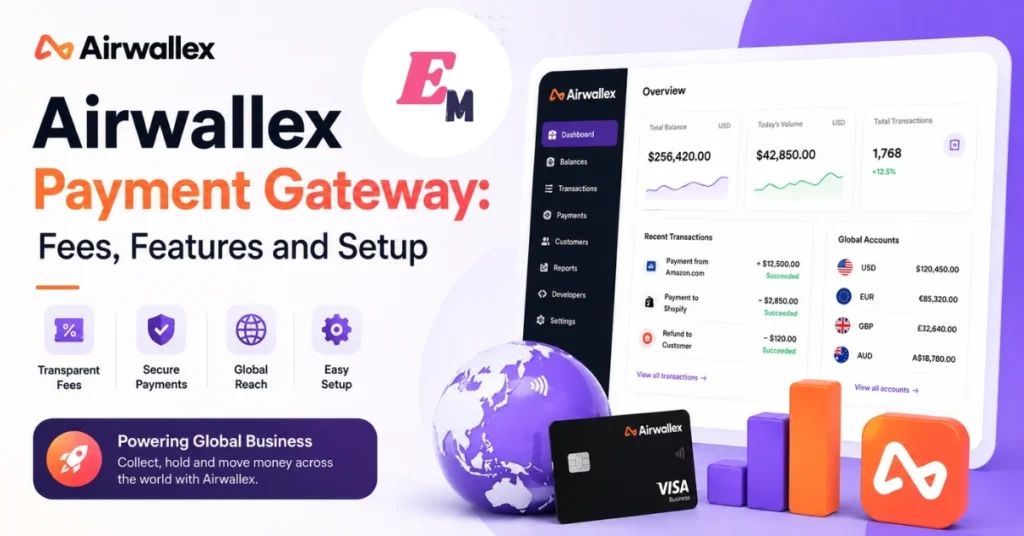
The Airwallex payment gateway helps businesses accept online payments across multiple markets. It combines payment processing, local payment methods, currency management and settlement tools within one business platform.
Airwallex may be useful for ecommerce stores, software companies, marketplaces and international service providers. However, its exact features, payment methods and pricing can depend on your location, business model and account setup.
This guide explains how Airwallex Payments works. It also covers checkout options, payment links, fees, settlement times, refunds, disputes and possible alternatives.
What Is the Airwallex Payment Gateway?
The Airwallex payment gateway is a system that connects a business checkout with a customer’s chosen payment method.
When a customer submits a payment, Airwallex sends the transaction through the correct payment network. The customer’s bank or payment provider then approves or rejects the request.
After approval, Airwallex captures the funds and prepares them for settlement. The money can then move into the business’s Airwallex Wallet or another configured settlement account.
Airwallex supports different online payment tools, including:
- Card payments
- Digital wallets
- Local payment methods
- Hosted checkout pages
- Embedded checkout elements
- Payment links
- QR code payments
- Ecommerce plugins
- Payment APIs
However, not every payment method is available in every country. Businesses should check Airwallex’s latest documentation before planning an integration.
Airwallex Payment Gateway at a Glance
| Feature | Airwallex Payments |
|---|---|
| Payment collection | Cards, digital wallets and selected local payment methods |
| Checkout options | Hosted checkout, embedded checkout, APIs, plugins and payment links |
| Payment links | Shareable payment links and QR codes |
| Invoicing | Invoice creation and management through Airwallex Billing |
| Settlement | Timing depends on the payment method, schedule and account configuration |
| Refunds | Full or partial refunds may be available for eligible payments |
| Disputes | Notifications and dispute-management workflows for supported methods |
| Currency support | Multi-currency collection and settlement options |
| Best suited for | International ecommerce, SaaS, marketplaces and global service businesses |
How Does the Airwallex Payment Gateway Work?
Airwallex sits between your website or payment page and the customer’s bank, card network or local payment provider.
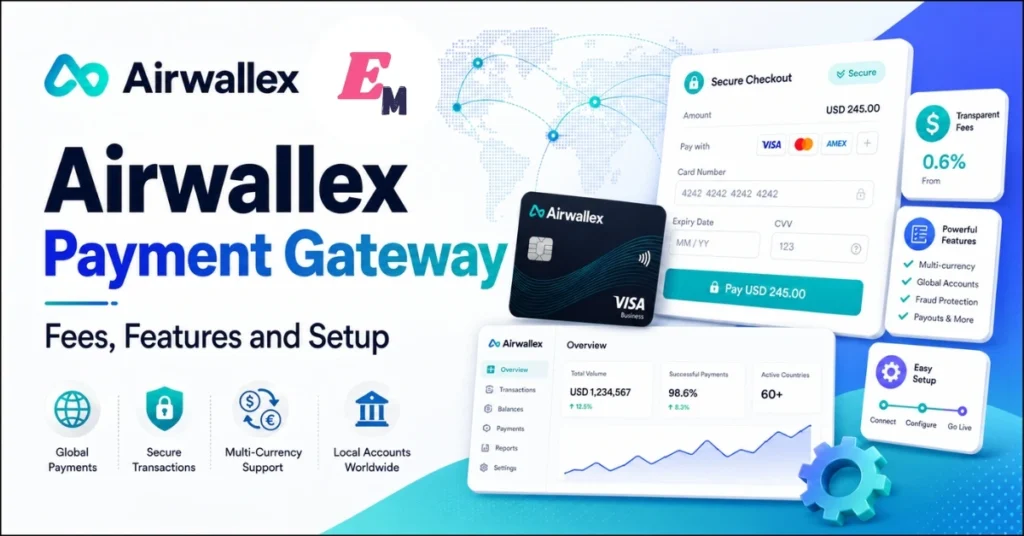
The exact process depends on your integration. For example, a hosted checkout works differently from a fully customized API integration. However, the basic payment flow remains similar.
Airwallex Payment Process
- A customer selects a product or service.
- The customer opens your checkout or payment link.
- Your website sends the payment request to Airwallex.
- Airwallex routes the request through the correct payment network.
- The bank or payment provider checks the transaction.
- The transaction is approved or declined.
- Airwallex captures the approved payment.
- Fees and adjustments are calculated.
- The remaining funds enter the settlement process.
- Available funds can be used for transfers, conversions or business spending.
A successful card payment does not always mean the money is immediately available. First, the payment must complete the required settlement period.
Therefore, businesses should understand both payment approval and settlement timing.
Airwallex Payment Methods
Airwallex can support cards, digital wallets and local payment methods. The available options depend on your business country, customer location, integration and account approval.
Common payment categories may include:
- Visa
- Mastercard
- American Express
- JCB
- UnionPay
- Apple Pay
- Google Pay
- WeChat Pay
- iDEAL
- Bank-based payment methods
- Region-specific local payment options
Offering local payment methods may improve the customer experience. For example, a shopper may trust a familiar regional payment method more than an international card form.
In addition, showing prices in local currencies may help customers understand the total cost. It can also reduce confusion during checkout.
Still, businesses should not assume that every listed method is automatically enabled. Some methods require separate activation, technical setup or account review.
Multi-Currency Payment Collection
Airwallex is designed for businesses that sell in more than one country. It allows eligible businesses to collect payments in different currencies and manage the funds through their Airwallex account.
Multi-currency collection can be helpful when customers prefer to pay in their own currency. Instead of showing every customer a price in US dollars, a store may display prices in pounds, euros or another supported currency.
This can create a more local checkout experience.
Airwallex also promotes like-for-like settlement for eligible currency flows. This means a payment collected in one currency may settle in that same currency instead of being automatically converted.
For example, a UK business may collect a customer payment in euros and keep the balance in euros. The business can then decide when to convert or use those funds.
Availability depends on the account, currency and payment route. Therefore, businesses should confirm the settlement rules before launching.
Airwallex Checkout Options
Airwallex provides several ways to add payment acceptance to a website, app or sales process.
Hosted Checkout
A hosted checkout sends customers to a payment page managed by Airwallex.
This option may reduce the amount of payment infrastructure a business must build. It can suit small teams that want a faster and more controlled setup.
Because the payment page is hosted, Airwallex manages much of the payment interface. However, businesses may have less control over the complete checkout design.
Read Also Article: Airwallex Review 2026: Features, Fees, Pros & Cons
Embedded Checkout
Embedded checkout allows businesses to place payment fields or payment elements directly inside their website.
Customers can complete the payment without moving to a separate page. As a result, the checkout may feel more connected to the store’s design.
Embedded checkout normally requires more technical work. Businesses must also review the relevant PCI DSS compliance requirements.
Airwallex documentation indicates that some embedded setups may qualify for PCI DSS SAQ A. Even so, businesses remain responsible for following the correct security and compliance process.
Payments API
The Airwallex Payments API gives development teams more control over the payment experience.
A business can use APIs to create payments, check transaction status, manage payment attempts and build custom workflows.
This option can work well for:
- SaaS platforms
- Mobile applications
- Online marketplaces
- Subscription services
- Custom ecommerce platforms
- Businesses with internal development teams
However, an API integration requires proper testing, error handling and security controls.
Ecommerce Plugins
Airwallex also offers payment plugins for selected ecommerce platforms.
Plugins can reduce development time because the basic connection is already prepared. Nevertheless, compatibility and payment-method support may vary by platform.
Before installing a plugin, check:
- Supported platform version
- Available payment methods
- Supported currencies
- Refund functions
- Webhook support
- Plugin maintenance history
- Checkout compatibility
Airwallex Payment Links and QR Codes
Airwallex payment links allow businesses to collect payments without building a complete ecommerce checkout.
A business creates a payment page and shares its link with the customer. The link can be sent through email, messaging apps, invoices or social media.
In addition, a QR code can direct customers to the payment page.
Payment links may be useful for:
- Freelancers
- Consultants
- Social media sellers
- Remote service providers
- Event businesses
- Small wholesale orders
- Customer support teams
- Manual sales requests
Airwallex says payment links can be created through its web application, API or both.
Supported methods may include cards, digital wallets and selected local payment options. However, the actual methods shown to a customer depend on location and account configuration.
Before sharing a payment link, confirm the amount, currency, description and expiry settings.
Airwallex Invoicing Features
Airwallex Billing includes invoice-management tools for eligible accounts.
Businesses may be able to create, duplicate, void, delete or mark invoices as paid. These controls can help teams manage customer billing from one location.
For example, a consulting company may issue an invoice after completing a project. The customer can then follow the payment instructions included with that invoice.
Invoice tools can be helpful for businesses that do not process every sale through a traditional shopping cart.
However, feature availability may differ by region and account type. Businesses should review the current Airwallex Billing documentation before depending on a specific workflow.
Airwallex Settlement Times
Settlement is the process of moving processed funds into the business’s available balance.
Airwallex generally describes settlement schedules using a T+N model.
In this format:
- T means the transaction date.
- N means the number of days before settlement.
For example, T+2 usually means that settlement happens two eligible days after the transaction date.
Most card and direct debit settlement schedules count business days. However, some local payment methods may count calendar days.
Settlement timing can depend on:
- Payment method
- Transaction currency
- Customer location
- Business location
- Daily cut-off time
- Weekends and public holidays
- Account risk settings
- Settlement configuration
- Refunds or payment adjustments
Once the funds appear in the available balance, they may be used for approved payouts, transfers, currency conversions or card spending.
Businesses should not promise customers or suppliers an exact payout date without checking the actual transaction status.
Airwallex Refunds
Airwallex supports refunds for eligible payments. Businesses may issue full or partial refunds when the payment status and payment-method rules allow it.
However, the refund option may not appear in every situation.
A refund may be unavailable when:
- The payment is still pending
- The payment failed
- The payment was not captured
- A dispute or chargeback is already active
- The payment method’s refund period has ended
- The transaction was already fully refunded
- The payment method does not support that refund type
For card refunds, Airwallex may display an Acquirer Reference Number. This number can help the customer’s bank trace the refund.
Refunds are not always instant. Even after a merchant submits the refund, the customer’s bank may need additional time to add the money back to the account.
Therefore, businesses should explain that refund processing and bank posting are separate stages.
Disputes and Chargebacks
A dispute happens when a customer questions a payment or claims that it was not valid.
Card-based payments, including some Apple Pay and Google Pay transactions, may enter a card-network dispute process.
When Airwallex receives a dispute notification, it may inform the business through email, webhooks or the Airwallex dashboard.
The business may then need to respond with evidence.
Useful evidence can include:
- Customer order details
- Delivery confirmation
- Tracking information
- Signed agreements
- Customer communication
- Login or usage records
- Refund policies
- Checkout terms
- Service-completion records
Deadlines are important. Missing a dispute deadline can reduce the business’s chance of challenging the claim.
Local payment methods may use different dispute rules. Therefore, teams should not apply card chargeback procedures to every payment type.
Airwallex Payment Gateway Fees
Airwallex payment costs can include several fee components.
The final cost may depend on your country, business type, monthly volume, payment method, card location, currency and pricing agreement.
Interchange Fees
The interchange fee is generally paid to the bank that issued the customer’s card.
Its amount may vary based on the card type, transaction location and card-network rules.
Scheme Fees
Scheme fees are paid to card networks for using their payment infrastructure.
Card networks set their own rules and fee structures. Therefore, these charges may differ between Visa, Mastercard and other supported networks.
Acquirer Fees
The acquirer fee covers services related to processing, risk management and settlement.
This is normally the part charged by the payment processor or acquiring provider.
Interchange++ Pricing
Under an Interchange++ model, interchange, scheme and processing costs are shown as separate components.
This model may provide more detail. However, monthly costs can be less predictable because some fee components vary.
Blended Pricing
Blended pricing combines several cost components into a single rate.
It may be easier to understand. On the other hand, it may provide less detail about the separate fees behind each transaction.
Other Costs to Review
Businesses should also check for:
- International card fees
- Currency-conversion costs
- Local payment-method fees
- Refund fees
- Dispute or chargeback fees
- Payment-link fees
- Minimum monthly commitments
- Account or platform charges
- Payout fees
- Custom integration costs
Pricing can change. Always review the latest Airwallex pricing page and your individual agreement before making a decision.
Who Should Consider Airwallex Payments?
Airwallex may suit businesses that need international payment collection and currency management within one platform.
Potential users include:
- International ecommerce stores
- SaaS businesses
- Online marketplaces
- Digital service providers
- Travel businesses
- Subscription platforms
- Export companies
- Remote agencies
- Businesses paying overseas suppliers
For example, an ecommerce company may collect payments in several currencies and hold those balances for supplier payments.
Similarly, a SaaS company may use APIs to build a customized checkout for customers in different markets.
However, a small local business that only accepts domestic payments may not need every international feature.
Airwallex Advantages and Limitations
Potential Advantages
- Supports international payment collection
- Offers several checkout integration options
- Includes payment links and QR codes
- Provides multi-currency account features
- Supports selected local payment methods
- Offers API tools for custom platforms
- Includes refund and dispute-management workflows
- May support like-for-like currency settlement
Potential Limitations
- Payment methods vary by country
- Pricing may require detailed comparison
- Some integrations need development skills
- Settlement is not always immediate
- Account approval may depend on the business type
- Refund and dispute rules vary by payment method
- Advanced setups may require compliance work
- Not every feature is available in every market
Wise Business as an Airwallex Alternative
Wise Business is another option for companies that send, receive, hold and convert money internationally.
However, Wise Business and Airwallex Payments do not always serve the same purpose.
Airwallex provides online payment-gateway and checkout tools. Wise Business is mainly focused on international business accounts, transfers, currency conversion and payment operations.
According to the information provided for this article, ecommerce payment acceptance for Wise customers is still being introduced. Businesses should check the latest availability before choosing Wise for card-payment collection.
Wise Business features may include:
- Sending money to supported countries
- Receiving money in multiple currencies
- Local account details for selected currencies
- Holding and converting different currencies
- Batch payments
- International payroll
- Business debit cards
- Team expense management
- Accounting-software connections
- Payment approval controls
- Invoice creation
- Payment links and QR codes where eligible
- API-based payout automation
Wise often uses the mid-market exchange rate with a separate conversion fee. However, fees, account setup charges and feature availability depend on the business location and service selected.
Investment-related Wise products involve capital risk. They are different from standard cash balances and should be reviewed carefully before use.
Airwallex vs Wise Business
| Area | Airwallex | Wise Business |
|---|---|---|
| Online checkout | Available through payment products and integrations | Availability may be limited or developing |
| Payment gateway | Yes, for eligible businesses | Not the main purpose of the platform |
| International transfers | Available | A major Wise Business feature |
| Multi-currency balances | Available | Available |
| Local account details | Available in supported markets | Available for selected currencies |
| Payment links | Available | Available for eligible customers |
| API access | Payment and financial APIs | Payout and account automation APIs |
| Best suited for | Businesses accepting and managing global payments | Businesses sending, receiving and converting money |
The better option depends on your main goal.
Choose a payment-gateway-focused platform when you need customer checkout, payment processing and local payment methods.
Choose an international account platform when your main needs are transfers, currency conversion, receiving money and paying suppliers.
Some businesses may use both platforms for different parts of their financial operations.
Final Verdict
The Airwallex payment gateway offers a broad set of tools for businesses selling across multiple markets.
It supports online checkout, cards, digital wallets, local payment methods, payment links, refunds and dispute management. In addition, multi-currency settlement tools may help businesses manage international income more efficiently.
Still, businesses should carefully review pricing, settlement timing, payment-method availability and technical requirements.
Before opening an account, compare Airwallex with other payment processors based on your countries, currencies, sales volume and integration needs.
Most importantly, confirm every feature and fee directly with Airwallex before building your payment system around it.
Frequently Asked Questions
Is Airwallex a payment processor or payment gateway?
Airwallex provides both payment-gateway and payment-processing features. Eligible businesses can accept payments through checkout pages, APIs, plugins, embedded elements and payment links.
Does Airwallex support invoices?
Airwallex Billing includes invoice-management features for eligible accounts. Businesses may be able to create, duplicate, void, delete or mark invoices as paid.
How long does Airwallex settlement take?
Settlement timing depends on the payment method, currency and account setup. Airwallex commonly uses a T+N schedule, where N represents the number of eligible days before settlement.
Can I create an Airwallex payment link?
Yes. Airwallex allows eligible businesses to create payment links through its web application or Payment Links API. Customers can then use supported payment methods to complete the payment.
Does Airwallex support refunds and chargebacks?
Airwallex supports refunds for eligible payments and provides dispute-management tools for supported payment methods. Refund limits, evidence requirements and deadlines can vary.