


Wise vs Payoneer Business: 2026 Guide for Global Payments
Wise vs Payoneer Business is not a simple “which brand is better” question. The better choice depends on how your business receives money, converts currency, pays suppliers, and tracks transactions.
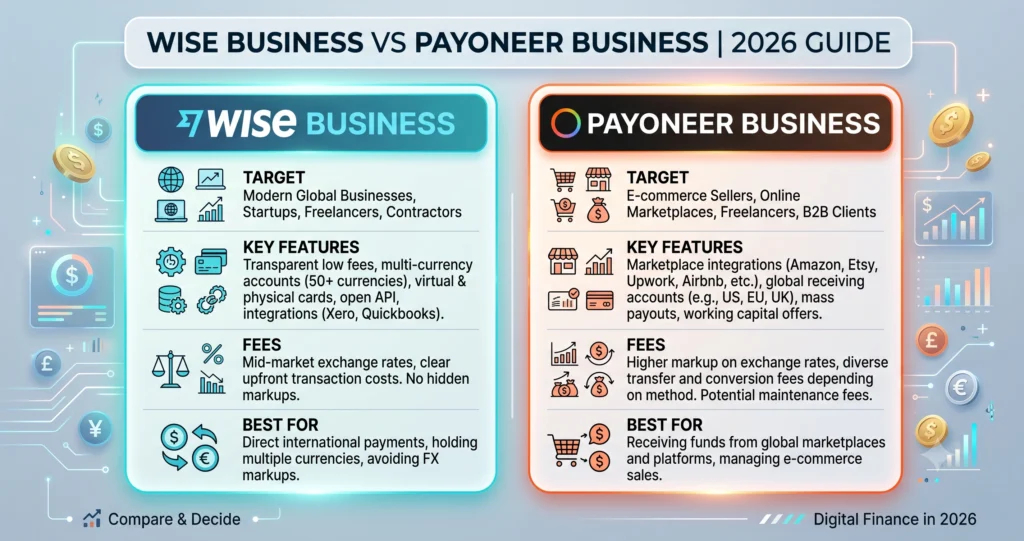
For many businesses, Wise Business is stronger for clear currency conversion and direct international transfers. Payoneer is often stronger for marketplace payouts, ecommerce sellers, and platform-based income. In many cases, using both tools gives better results than choosing only one.
Wise says its business account helps companies manage money in 40+ currencies, while Payoneer promotes global receiving, marketplace payout, and business payment services for cross-border companies.
Quick Answer: Wise vs Payoneer Business
Choose Wise Business if your main goal is to send money abroad with clear fees, transparent exchange rates, and strong multi-currency control.
Choose Payoneer if your main goal is to receive money from marketplaces, ecommerce platforms, freelance platforms, or global partner networks.
A smart setup for many online businesses is simple: receive marketplace payments through Payoneer when the platform supports it well, then compare Wise for outbound contractor payments, supplier transfers, or FX-heavy business routes.
Key Takeaways
Wise Business usually works best for direct international payments, supplier transfers, contractor payouts, and clear exchange-rate planning.
Payoneer usually works best for marketplace sellers, freelancers, ecommerce businesses, and companies that need platform-native payout options.
However, neither platform wins every route. Fees, speed, supported countries, receiving methods, verification rules, and withdrawal options can change by country and currency.
Therefore, the best decision is to test your top three payment routes before moving large volume.
Wise vs Payoneer Business Comparison Table
| Feature | Wise Business | Payoneer Business |
|---|---|---|
| Best for | Direct international transfers and FX clarity | Marketplace payouts and ecommerce receiving |
| Strongest use case | Paying global contractors and suppliers | Receiving from platforms and clients |
| FX style | Clear mid-market-rate focused experience | Route-dependent currency conversion |
| Marketplace support | Useful, but not always platform-native | Strong marketplace and partner ecosystem |
| Multi-currency use | Strong for holding and converting currencies | Strong for receiving and platform payouts |
| Fee visibility | Often clearer before sending | Can depend more on route and payment method |
| Best strategy | Use for outbound and FX-heavy payments | Use for inbound marketplace income |
What Businesses Really Mean by “Wise vs Payoneer Business”
Most people searching for Wise vs Payoneer Business want a practical answer. They do not want theory. They want to know which account will save money, avoid delays, and make accounting easier.
The real question is not “Which company is more popular?” Instead, ask:
Which one is cheaper for my exact payment routes?
Which one receives money from my clients or marketplaces more smoothly?
Which one gives clearer reports for my accountant?
Which one is available in my country?
Which one reduces payment risk for my business?
For example, a freelance agency that pays designers in several countries may prefer Wise for recurring payouts. Meanwhile, an Amazon, Fiverr, Upwork, or ecommerce seller may depend on Payoneer because the payout connection is already built into the platform.
Wise Business Overview
Wise Business is designed for companies that need to send, receive, hold, and convert money across currencies. It is popular with agencies, remote teams, SaaS businesses, importers, consultants, and global service providers.
Wise’s pricing pages show that transfer fees vary by currency and account region. For example, Wise’s US Business pricing page lists sending money from 0.57%, while its UK Business pricing page lists sending money from 0.33%. This means you should always check your own country, currency, and amount before deciding.
Wise also says it uses the mid-market exchange rate on its currency converter, which helps businesses compare the rate against a neutral market reference.
Wise Business Is Best For
Wise Business is a strong fit if you:
Need to pay contractors in different countries.
Want clear exchange-rate information before sending.
Send regular supplier payments.
Prefer transparent transfer pricing.
Need a multi-currency account for business operations.
Want stronger control over landed transfer cost.
However, Wise may not be the best first choice when your income comes mainly from marketplaces that already prefer Payoneer.
Payoneer Business Overview
Payoneer is widely used by freelancers, marketplace sellers, ecommerce businesses, and digital companies that receive international payments. Its strength is not only the account itself. Its real value often comes from its platform and marketplace connections.
Payoneer offers local receiving accounts and says businesses can receive payments in currencies such as USD, EUR, GBP, JPY, and CAD, depending on eligibility and setup. It also offers marketplace payout solutions for platforms that pay sellers globally.
Payoneer also promotes business services for sending and receiving cross-border payments with clients, contractors, and suppliers.
Payoneer Business Is Best For
Payoneer is a strong fit if you:
Receive payouts from marketplaces.
Sell products or services through global platforms.
Need local receiving details for client payments.
Want a payout method many platforms already support.
Run an ecommerce or freelance business.
Need marketplace-friendly collection workflows.
However, Payoneer costs can vary by payment method, withdrawal route, and platform. Therefore, you should check the exact fee inside your account before depending on one route.
Wise vs Payoneer Fees: How to Compare the Real Cost
The biggest mistake is comparing only the visible transfer fee. That gives an incomplete answer.
Instead, compare the full cost from start to finish. This is the only fair way to compare Wise vs Payoneer Business.
Check These Six Fee Areas
First, check the upfront transfer fee.
Next, compare the exchange rate against the mid-market rate.
Then, look for receiving fees or withdrawal fees.
After that, check card fees if you spend from the account.
Also, watch for intermediary bank deductions on wire routes.
Finally, include accounting time because messy records cost real money.
Payoneer’s pricing page says its manage-currencies fee is 0.50%, while its fee resources also note that direct receiving, card payments, and platform payments can vary by method.
Wise’s pricing pages show fees before use and explain that pricing changes by currency and payment type.
Expert Tip
Do not compare one $50 transfer and make a final decision. Small transfers can make fixed fees look larger. Larger transfers can make exchange-rate differences more important.
Instead, test three amounts: a small payment, a normal monthly payment, and a larger supplier or payroll-style payment.
Speed and Reliability
Payment speed matters because late payments damage trust. One delayed contractor or supplier payment can create more stress than a small fee difference.
Wise often gives businesses a clear estimated delivery time before sending. However, delivery still depends on currency, payment method, banking hours, local checks, and recipient bank rules.
Payoneer can be very useful inside marketplace ecosystems because many platforms already support it. However, withdrawal timing may still depend on the payout channel, bank route, currency, and account checks.
The safest business habit is to keep a payment buffer. For example, keep two to four weeks of operating funds in your main currency. As a result, one delayed route will not stop payroll, supplier payments, or project delivery.
Invoicing, Cards, and Team Controls
The best payment platform is not only cheap. It must also fit your daily workflow.
Wise supports team finance features such as spending limits, payment approvals, and debit card controls for eligible business accounts.
Payoneer offers business payment services that help companies receive, manage, and send funds across borders. Its account can also support local receiving accounts and currency management, depending on country and eligibility.
Invoicing and Receiving
For direct client work, payment instructions must be simple. If clients struggle to pay you, the platform is not helping.
Wise can work well when you invoice clients directly and want clear account details where available. Payoneer can work well when clients, marketplaces, or ecommerce platforms already recognize it.
Cards and Spending
Cards are useful for subscriptions, ads, tools, hosting, software, and travel. However, availability changes by country.
Before choosing, check:
Virtual card availability.
Physical card availability.
ATM fees.
Currency conversion rules.
Team card controls.
Monthly or annual card costs.
Accounting and Reports
Accounting is where many businesses feel hidden pain. A cheap payment route can become expensive if it creates unclear records.
Before using either platform heavily, export transactions for one month. Then check whether your accountant can easily match invoices, payouts, fees, conversions, and withdrawals.
Trust, Safety, and Compliance
Wise and Payoneer are both major financial technology companies, but you should still verify safety details for your country.
Wise says it is licensed to hold customer money and follows rules set by regulators in the countries where it operates. Wise also explains that customer funds are protected through cash, secure liquid assets, or comparable guarantees, depending on the entity and region.
Payoneer says its US entity is registered as a Money Services Business with FinCEN and has state-level money transmitter licensing where required. It also lists state licenses and disclosures publicly.
In June 2026, Payoneer and Nuvei announced a definitive agreement for Nuvei to acquire Payoneer for about $2.75 billion, with closing expected in mid-2027 if shareholder and regulatory approvals are completed. Businesses using Payoneer for long-term payment planning should monitor any product or terms updates during this period.
Safety Checklist
Use two-step verification.
Give team members only the access they need.
Set approval rules for large transfers.
Keep backup payout routes.
Review legal terms in your country.
Check support options before problems happen.
Do not hold more idle money than your business needs.
Practical 90-Day Testing Plan
A 90-day test gives a better answer than reading ten generic reviews.
Start by choosing your top three payment routes. For example:
USD client payment to local bank.
EUR marketplace payout to business account.
GBP balance converted and paid to a contractor.
Next, run the same type of transaction through both Wise and Payoneer where possible.
Track these details:
Amount sent or received.
Currency conversion rate.
Total fees.
Final amount received.
Delivery time.
Documents requested.
Ease of reconciliation.
Support response quality.
After one billing cycle, compare the final numbers. In many cases, the better choice becomes clear quickly.
Pros and Cons of Wise Business
Pros
Wise often gives clear pricing before you send.
It works well for international contractor payments.
The FX experience is easy to understand.
Multi-currency workflows are strong.
Team controls can help growing businesses.
Cons
Some features vary by country.
Not every marketplace supports Wise as smoothly.
Business account details are not identical everywhere.
Some routes may still face banking delays.
Pros and Cons of Payoneer Business
Pros
Payoneer is strong for marketplace payouts.
Many freelancers and sellers already use it.
Local receiving accounts can help with global clients.
It fits ecommerce and platform-based income well.
Its ecosystem is useful for online sellers.
Cons
Total cost can vary by payment route.
Some fees need careful checking inside the account.
Withdrawals may depend on local banking rails.
Marketplace payout rules can differ by platform.
How to Choose in 10 Minutes
Use this simple decision method.
First, list your top three inbound routes.
Second, list your top three outbound routes.
Third, check live fees in both platforms.
Fourth, compare the final received amount.
Fifth, check estimated delivery time.
Sixth, review accounting export quality.
Finally, choose the tool that works best for your highest-volume route.
For example, if 80% of your money comes from marketplaces, Payoneer may be your main receiving tool. However, if 80% of your expenses are international contractor payments, Wise may be better for outbound transfers.
Final Verdict: Wise vs Payoneer Business
Wise Business is often the better choice for businesses that care most about transparent FX, direct global transfers, and predictable outbound payments.
Payoneer is often the better choice for marketplace sellers, ecommerce businesses, freelancers, and companies that receive money through partner platforms.
Overall, the best setup may be a hybrid payment stack. Use Payoneer where marketplace receiving is easier. Then use Wise where direct transfers, FX comparison, and contractor payouts are stronger.
Before making a full switch, test your real routes with real numbers. That one step can save money, reduce delays, and make your finance process easier.
FAQ: Wise vs Payoneer Business
Wise can be cheaper for FX-heavy international transfers, especially when the exchange-rate difference matters. However, Payoneer may be better for marketplace payouts. Always compare your exact route, currency, amount, and withdrawal method.
Payoneer is often better for marketplace sellers because many platforms support Payoneer payouts directly. However, Wise can still be useful for paying suppliers, contractors, or converting money after receiving income.
Yes. Many businesses use both. For example, you can receive marketplace income through Payoneer and use Wise for some international transfers or contractor payments.
Wise Business is often strong for direct contractor payouts because it focuses on clear transfer pricing and currency conversion. However, the best option depends on the contractor’s country, currency, and preferred receiving method.
Both companies operate through regulated frameworks in major markets. However, you should still check the legal entity, safeguarding rules, support options, and account security settings for your own country before holding or moving large balances.