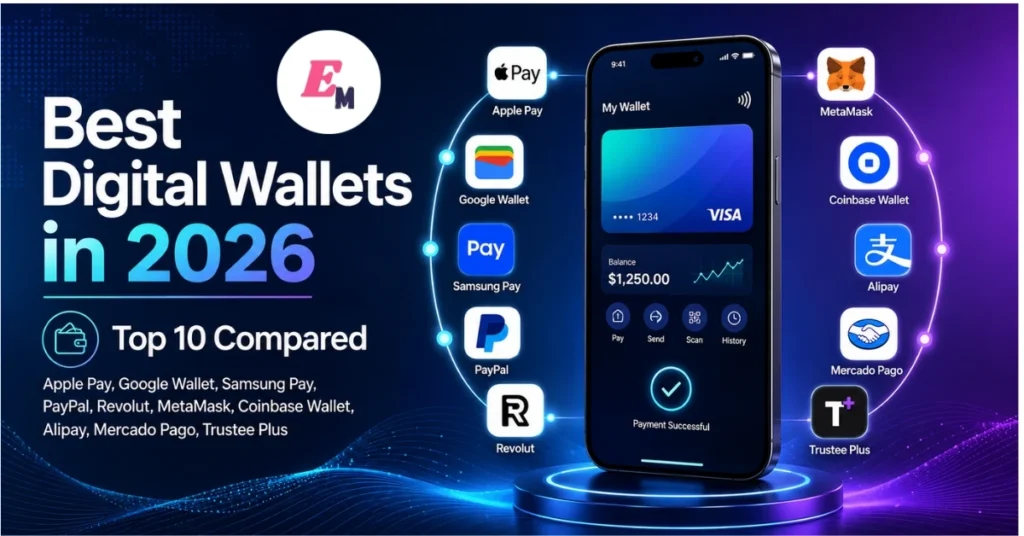

Best Digital Wallets in 2026: Top 10 Wallet Apps Compared
Digital wallets have changed how people pay, shop, travel, and manage money. A few years ago, a digital wallet was mainly a phone app that stored debit or credit cards. In 2026, it can also hold digital IDs, loyalty cards, crypto, stablecoins, transit passes, and even spending rules for AI assistants.
A digital wallet is an app or payment tool that stores payment details safely and lets users pay online, in stores, or through mobile devices. Most wallets use tokenization, biometric login, and encryption to protect card details. As a result, they are often safer than carrying a physical wallet.
However, not every wallet is built for the same user. Apple Pay works best for iPhone users. Google Wallet is a strong choice for Android users. PayPal is still useful for online shopping. Meanwhile, MetaMask and Coinbase Wallet are better for crypto and Web3 users.
Therefore, the best digital wallet in 2026 depends on your device, country, payment habits, privacy needs, and whether you use crypto.
Key Takeaways
- Apple Pay and Google Wallet are the best everyday choices for most users.
- PayPal is still one of the most useful online payment wallets.
- Revolut is strong for travelers and multi-currency users.
- MetaMask and Coinbase Wallet are best for crypto and Web3.
- Alipay and Mercado Pago are powerful regional wallets.
- No single wallet is perfect for every use case.
- Most people get better results by using two or more wallets.
How Digital Wallets Work in 2026
Digital wallets do not usually share your real card number with a store. Instead, they create a secure digital token. When you tap your phone or pay online, the merchant receives that token, not your actual card details.
This makes payments safer because stolen tokens are usually useless outside that specific transaction. In addition, most digital wallets require Face ID, fingerprint login, PIN codes, or device-level security before a payment is approved.
For in-store payments, wallets often use NFC technology. This is the same contactless technology used by tap-to-pay cards. For online payments, wallets fill in payment details quickly, so users do not need to type card numbers again and again.
In 2026, many wallets are also moving beyond payments. Some now support digital IDs, AI shopping tools, crypto payments, budget alerts, and cross-border transfers.
Main Types of Digital Wallets
Mobile Wallets
Mobile wallets are apps on your phone or smartwatch. They store payment cards and allow tap-to-pay transactions. Apple Pay, Google Wallet, and Samsung Pay are common examples.
They are best for daily purchases, transit payments, grocery shopping, and quick checkout in stores.
Online Wallets
Online wallets are made for internet checkout. They help users pay without typing card details every time. PayPal is one of the most popular examples.
These wallets are useful for online shoppers, freelancers, and small businesses that send or receive payments.
Crypto Wallets
Crypto wallets store digital assets such as Bitcoin, Ethereum, stablecoins, and NFTs. Some wallets are custodial, while others are non-custodial.
A non-custodial wallet gives the user control over private keys. However, this also means the user must protect recovery phrases carefully.
Hybrid Fiat-Crypto Wallets
Hybrid wallets support both regular money and crypto assets. Revolut and Trustee Plus are examples of this type.
These wallets are helpful for travelers, crypto users, and people who want one app for different currencies.
Superapp Wallets
Superapp wallets combine payments with many other services. For example, users may pay bills, book rides, shop online, access financial tools, and manage IDs inside one app.
Alipay is one of the strongest examples of a superapp wallet.
P2P Wallets
Peer-to-peer wallets help people send money to friends, family, or small sellers. They are useful for bill splitting, local payments, and quick personal transfers.
Top 10 Best Digital Wallets in 2026
1. Apple Pay: Best for iPhone Users
Apple Pay remains one of the best digital wallets in 2026 for iPhone, Apple Watch, iPad, and Mac users. It works smoothly inside the Apple ecosystem and supports fast contactless payments.
The biggest advantage is ease of use. Users can pay with Face ID, Touch ID, or a device passcode. In addition, Apple Pay uses strong device-level security and does not show your real card number to merchants.
Apple Pay is ideal for in-store payments, app purchases, transit payments, and online checkout. However, it only works on Apple devices. Therefore, Android users will need another wallet.
Best for: iPhone users, Apple Watch users, travelers, and people who want a simple payment experience.
Potential drawback: It is not available for Android phones.
2. Google Wallet: Best for Android Users
Google Wallet is one of the best digital wallets for Android users in 2026. It can store debit cards, credit cards, boarding passes, event tickets, loyalty cards, and digital IDs in supported locations.
The app works across Android phones, Wear OS watches, and Chrome. As a result, it is very useful for users who already rely on Google services like Gmail, Maps, and Chrome.
Google Wallet is also strong for online shopping. It can speed up checkout and reduce the need to enter payment details manually.
However, privacy-focused users may want to review Google’s data settings before using it heavily.
Best for: Android users, online shoppers, travelers, and Google ecosystem users.
Potential drawback: Some users may have concerns about data privacy.
3. Samsung Pay: Best for Samsung Device Owners
Samsung Pay is a strong mobile wallet for people who use Samsung phones and watches. It is built around Samsung’s device ecosystem and security tools.
One of Samsung Pay’s strengths has been its ability to support payments on many types of terminals. This can be useful in areas where payment hardware is not fully updated.
Samsung also connects its wallet with Samsung Knox security. This helps protect payment data on the device.
However, Samsung Pay is most useful when you stay inside the Samsung ecosystem. If you switch to another Android brand, the experience may not be the same.
Best for: Samsung users, frequent shoppers, and users who want hardware-based mobile payment security.
Potential drawback: It depends heavily on Samsung devices.
4. PayPal: Best Online Wallet for Global Shopping
PayPal is still one of the most recognized online wallets in the world. It is accepted by many websites, marketplaces, freelancers, and small businesses.
The main benefit of PayPal is trust. Many shoppers feel safer paying with PayPal because they do not need to enter card details directly on every website.
PayPal also works well for international payments, online invoices, and business checkout. In addition, some users can access buyer protection features, depending on the payment type and region.
However, PayPal fees can be higher than some newer payment platforms, especially for business transactions and currency conversion.
Best for: Online shoppers, freelancers, marketplace sellers, and small business owners.
Potential drawback: Fees can be expensive for business and international payments.
5. Revolut: Best for Travel and Multi-Currency Use
Revolut is more than a digital wallet. It works like a mobile finance app with multi-currency accounts, spending tools, cards, and crypto access in some markets.
It is especially useful for people who travel or receive money in different currencies. Users can often hold and exchange multiple currencies inside the same app.
Revolut also offers budgeting tools, spending alerts, and card controls. Therefore, it can help users manage money more actively than a basic wallet.
However, Revolut’s banking protections vary by country. Before holding large balances, users should check what protection applies in their region.
Best for: Travelers, remote workers, freelancers, and users who deal with multiple currencies.
Potential drawback: Deposit protection and features may differ by country.
6. MetaMask: Best Web3 and DeFi Wallet
MetaMask is one of the most popular crypto wallets for Web3 users. It is widely used for decentralized apps, NFTs, DeFi platforms, and blockchain transactions.
The wallet supports Ethereum and many other networks through added settings and extensions. It also allows users to connect directly with Web3 websites.
MetaMask gives users strong control over their crypto. However, that control comes with responsibility. Users must protect their seed phrase and understand gas fees, networks, and transaction approvals.
For beginners, MetaMask can feel confusing at first. Even so, it remains one of the most important wallets in the crypto world.
Best for: Crypto users, DeFi users, NFT collectors, and Web3 developers.
Potential drawback: It can be difficult for beginners.
7. Coinbase Wallet: Best Crypto Wallet for Beginners
Coinbase Wallet is a user-friendly crypto wallet that supports many digital assets. It is separate from the Coinbase exchange, but it works well for users who already know the Coinbase brand.
The wallet is easier to use than many advanced Web3 wallets. It can store crypto, stablecoins, NFTs, and other blockchain assets.
Coinbase Wallet is also becoming important for newer crypto payment systems and developer tools. As a result, it may appeal to users who want to explore the future of digital payments.
However, users should compare fees when buying or converting crypto. Some costs may be higher than other platforms.
Best for: Crypto beginners, Coinbase users, stablecoin users, and people exploring Web3 payments.
Potential drawback: Crypto purchase and conversion fees can vary.
8. Alipay: Best Superapp Wallet for Asia
Alipay is one of the strongest digital wallets in Asia. It is more than a payment app because it also connects with shopping, financial tools, travel services, and daily lifestyle features.
In China, Alipay is deeply connected with everyday payments. Many users rely on it for stores, restaurants, transport, bills, and online services.
Alipay+ also helps connect different wallets and merchants across parts of Asia. This makes it useful for cross-border travel and businesses that serve Asian customers.
However, users outside Asia may find limited acceptance or privacy concerns, depending on their country.
Best for: Users in China, travelers in Asia, and businesses serving Asian consumers.
Potential drawback: It may not be ideal as a global everyday wallet outside supported markets.
9. Mercado Pago: Best Digital Wallet for Latin America
Mercado Pago is a leading digital wallet in Latin America. It is connected to Mercado Libre, one of the region’s largest e-commerce platforms.
The app supports online payments, QR payments, cards, transfers, and other financial tools in supported countries. For many users, it also works as an alternative to traditional banking.
Mercado Pago is especially useful in countries like Brazil, Argentina, Mexico, Colombia, and Chile. It helps sellers accept payments and helps buyers shop more easily.
However, outside Latin America, its usefulness is limited.
Best for: Latin American users, Mercado Libre sellers, local shoppers, and underbanked users.
Potential drawback: It has limited acceptance outside the region.
10. Trustee Plus: Best for Crypto Spending and Privacy
Trustee Plus is a crypto-focused wallet that supports everyday spending in a practical way. It allows users to hold crypto and, in some cases, spend through a linked payment card.
This makes it useful for people who want to use digital assets without manually converting them each time. It also appeals to users who want more privacy than some traditional finance apps offer.
Trustee Plus uses modern wallet security methods, including key protection systems. However, it does not have the same mainstream reach as Apple Pay, Google Wallet, or PayPal.
Best for: Crypto users, privacy-focused users, and people who want to spend stablecoins or crypto.
Potential drawback: It is not a full replacement for a daily banking app.
Digital Wallet Comparison Table
| Digital Wallet | Best For | Main Strength | Main Limitation |
|---|---|---|---|
| Apple Pay | iPhone users | Smooth Apple ecosystem payments | Apple-only |
| Google Wallet | Android users | Strong Android and Chrome support | Privacy concerns for some users |
| Samsung Pay | Samsung users | Device-level security | Samsung-focused |
| PayPal | Online shoppers | Wide online acceptance | Higher fees in some cases |
| Revolut | Travelers | Multi-currency tools | Protections vary by country |
| MetaMask | Web3 users | DeFi and NFT access | Harder for beginners |
| Coinbase Wallet | Crypto beginners | Simple crypto experience | Fees can vary |
| Alipay | Asia users | Superapp features | Limited global use |
| Mercado Pago | Latin America | Local payments and commerce | Regional acceptance |
| Trustee Plus | Crypto spending | Crypto-to-fiat use cases | Smaller ecosystem |
How to Choose the Best Digital Wallet
Choosing the best digital wallet is easier when you focus on your daily needs. Do not choose a wallet only because it is popular.
First, check your phone type. If you use an iPhone, Apple Pay is the easiest default choice. If you use Android, Google Wallet is usually better.
Next, think about where you shop. If you buy online often, PayPal can still be useful. If you travel, Revolut may help with currency exchange and spending control.
Then, consider whether you use crypto. MetaMask is better for Web3 activity, while Coinbase Wallet may feel easier for beginners.
Finally, think about your region. Alipay is powerful in Asia. Mercado Pago is strong in Latin America. Local acceptance matters more than global brand awareness.
Pros and Cons of Digital Wallets
Pros
- Fast checkout online and in stores
- Less need to carry physical cards
- Strong security through tokenization
- Biometric approval for payments
- Useful for travel, rewards, and loyalty cards
- Some wallets support crypto and digital IDs
Cons
- Not every wallet works everywhere
- Features vary by country
- Some wallets charge high currency or business fees
- Crypto wallets require extra care
- Losing access to your phone or recovery phrase can cause problems
- Privacy policies differ between providers
Common Mistakes to Avoid
Many users install a wallet but do not check its settings. This can create privacy, security, or spending issues.
Avoid these common mistakes:
- Do not store large balances without checking protection rules.
- Do not ignore transaction fees, especially for currency exchange.
- Never share your wallet PIN, seed phrase, or recovery code.
- Do not approve unknown crypto transactions.
- Avoid using public Wi-Fi for sensitive financial actions.
- Keep your phone updated with the latest security patches.
Expert Tips for Safer Digital Wallet Use
Use biometric login whenever possible. In addition, set a strong phone passcode and enable remote device lock.
For crypto wallets, write your recovery phrase offline and store it safely. Never save it in screenshots, cloud notes, or email.
Also, review wallet permissions from time to time. Remove old cards, expired passes, and unused payment methods.
If you use multiple wallets, keep one for daily spending and another for higher-risk activities like crypto or online subscriptions.
Future of Digital Wallets After 2026
Digital wallets are moving toward invisible payments. In the future, users may not always tap a phone or enter a password. Instead, payments may happen through approved AI agents, biometric checkout, or smart rules set inside a wallet.
AI-powered payments may help users compare prices, choose the best card, apply rewards, or complete small purchases automatically. However, users will still need strong controls, spending limits, and alerts.
Digital identity will also become more important. Wallets may store driver’s licenses, government IDs, business credentials, and travel documents.
Meanwhile, crypto wallets may become easier to use. Stablecoins, tokenized payments, and programmable money could become more common in cross-border transfers and online services.
Overall, digital wallets are becoming the main control center for modern financial life.
Final Verdict: Which Digital Wallet Should You Use?
For most people, the best digital wallet in 2026 is not one app. It is a small mix of wallets for different needs.
Use Apple Pay if you have an iPhone. Use Google Wallet if you have Android. Keep PayPal for online shopping and international checkout. Choose Revolut if you travel or handle different currencies.
If you use crypto, add Coinbase Wallet or MetaMask. If you live in Asia, Alipay may be essential. If you are in Latin America, Mercado Pago is one of the strongest choices.
The right wallet should be secure, easy to use, accepted where you shop, and affordable for your payment habits. Before you choose, compare fees, country support, privacy settings, and security features.
FAQs
The best digital wallet depends on your device and needs. Apple Pay is best for iPhone users, while Google Wallet is best for Android users. PayPal is strong for online payments, and Revolut is useful for travelers.
Yes, most digital wallets are safe when used correctly. They often use tokenization, encryption, biometric login, and device security. However, users should still protect their phone, passwords, and recovery codes.
Some digital wallets can work without a traditional bank account, depending on the country and wallet type. For example, certain prepaid, crypto, or regional wallets may allow limited use without a bank.
Apple Pay is better for iPhone users because it works deeply inside the Apple ecosystem. Google Wallet is better for Android users because it works well with Android phones, Wear OS, Chrome, and Google services.
MetaMask is best for Web3, DeFi, and NFT users. Coinbase Wallet is better for beginners who want a simpler crypto wallet experience. Trustee Plus may suit users who want crypto spending options.