
Top 10 Digital Wallet Apps Powering the Cashless Future
Digital wallet apps have changed how people pay, send money, shop online, and manage daily finances. What started as a simple way to avoid carrying cash has now become a core part of modern financial life.
Today, the best digital wallet apps do much more than store cards. They support peer-to-peer transfers, tap-to-pay checkout, online shopping, travel passes, budgeting tools, rewards, crypto access, and even digital IDs in some markets.
A digital wallet is a mobile app or online service that stores payment details and lets users make secure payments without using a physical card or cash. Many wallets use tokenisation, biometric login, and device-level security to protect card details during transactions.
However, not every wallet works the same way. Some focus on in-store payments. Others are stronger for online checkout, global transfers, P2P payments, or financial super-app features. Because of this, the right wallet depends on where you live, how you spend, and what financial tools you need.
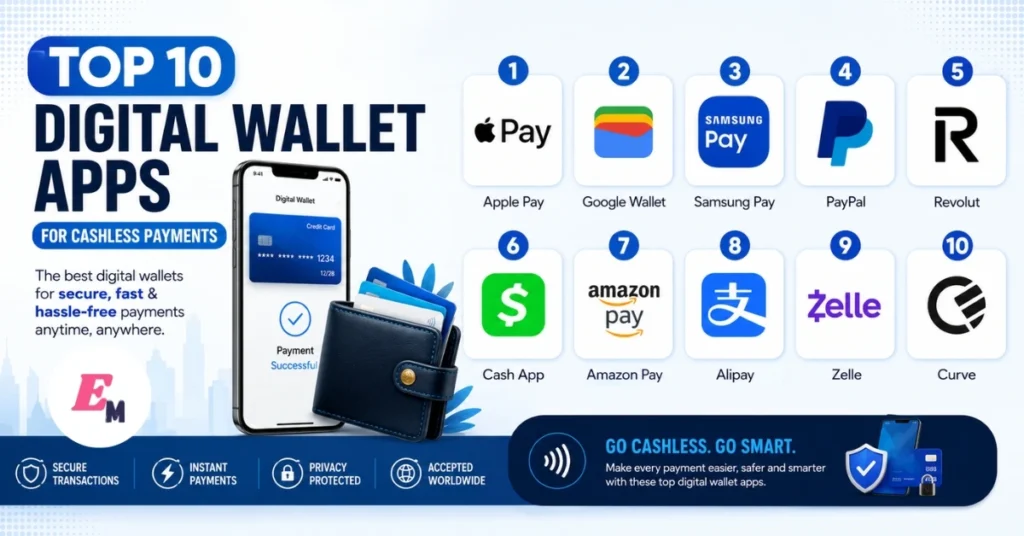
Below is a rewritten and improved ranking of 10 powerful digital wallet apps shaping the global cashless payment market.
Key Takeaways
Digital wallets are no longer just payment tools. They now act as financial hubs for spending, saving, sending, investing, and identity management.
Apple Pay and Google Wallet lead in mobile tap-to-pay adoption because they are deeply linked with iOS and Android devices.
PayPal, Amazon Pay, and Alipay remain strong in online checkout and merchant payments.
Cash App, Zelle, Revolut, and Curve show how wallets can serve more specific needs, such as P2P payments, money management, international spending, and card consolidation.
Still, users should always check fees, country support, fraud protection, and withdrawal rules before choosing a digital wallet.
What Makes a Digital Wallet App Powerful?
A strong digital wallet app should make payments easier without reducing safety. It should also fit naturally into a user’s daily life.
The best digital wallet apps usually offer:
- Fast mobile payments
- Strong security features
- P2P money transfers
- Online checkout support
- Card and bank account linking
- Spending insights
- Rewards or cashback options
- International payment support
- Merchant acceptance
- Easy account recovery
In addition, the most advanced wallets now include digital IDs, travel passes, loyalty cards, virtual cards, and investment tools. As a result, many apps have moved beyond payments and become full financial platforms.
Top 10 Digital Wallet Apps
10. Curve
Headquarters: London, United Kingdom
Founded: 2015
Best for: Combining multiple cards into one wallet
Curve is different from most digital wallet apps because it focuses on card consolidation. Instead of replacing your bank card, Curve lets users connect several debit, credit, and loyalty cards into one app and one smart payment experience.
This makes Curve useful for people who manage many cards. For example, a user can pay with Curve and later move the transaction to another linked card. Its well-known “Go Back in Time” feature lets users switch past payments to a different card, which can help with rewards, cash flow, or spending mistakes. Curve says this feature can move eligible transactions up to 120 days later.
Curve also promotes tools for foreign exchange savings, rewards, and spending control. Therefore, it appeals to frequent travelers, freelancers, and people who want better control over multiple cards.
In 2025, Lloyds Banking Group announced plans to acquire Curve to strengthen its digital wallet strategy, although official investor documents described the deal as subject to regulatory approval at that time.
Why Curve stands out
Curve is useful because it helps users manage payments after they happen. That is rare in the digital wallet market. However, availability, card support, and premium features may vary by country.
9. Zelle
Headquarters: Arizona, United States
Founded: 2017
Best for: Instant bank-to-bank P2P transfers in the United States
Zelle is one of the most important P2P payment networks in the United States. Unlike many wallet apps, Zelle is built directly into thousands of bank and credit union apps.
This means many users do not need to download a separate app. Instead, they can send money from their bank account using only a recipient’s email address or mobile number. Zelle says it is available in more than 2,400 banking and credit union apps, and payments to enrolled users usually arrive within minutes.
Zelle is powered by Early Warning Services, the company behind the network. The Zelle network launched in 2017 and is closely tied to major financial institutions in the U.S. banking system.
Why Zelle stands out
Zelle works well for fast transfers between trusted people. For example, users often use it to split rent, pay a friend, or send money to family.
However, users must be careful. Zelle payments can move quickly, and they are usually hard to reverse. Therefore, it is best to send money only to people or businesses you trust.
8. Revolut
Headquarters: London, United Kingdom
Founded: 2015
Best for: International spending and financial super-app features
Revolut began as a travel-friendly multi-currency card. Since then, it has grown into one of the most recognised fintech super-apps in Europe and beyond.
The app lets users spend, send, save, and manage money across borders. Revolut says it serves more than 75 million customers globally, supports transfers to more than 160 countries, and allows users to hold up to 36 currencies in the app.
In addition, Revolut offers budgeting tools, virtual cards, business accounts, stock trading, and crypto-related services in eligible markets. This makes it attractive for digital workers, travelers, startups, and users who want one app for several financial needs.
Revolut also received a full UK banking licence in 2026, which marked an important step in its move from fintech app to regulated banking provider in the UK.
Why Revolut stands out
Revolut is strong for international users because it combines currency tools, transfers, cards, and spending analytics. Even so, fees, protection rules, and product access can vary by region.
7. Amazon Pay
Headquarters: Washington, United States
Founded: 2007
Best for: Fast online checkout with Amazon account details
Amazon Pay is built around a simple idea: let shoppers use their existing Amazon account to pay on other websites. This reduces checkout friction because users can rely on payment methods already stored in their Amazon account.
According to Amazon Pay, customers can use the service wherever they see the Amazon Pay button. There is no need for a separate sign-up, and transactions can be tracked inside the user’s Amazon account.
For merchants, Amazon Pay can improve checkout speed because many shoppers already know and trust Amazon. In addition, Amazon Pay lets customers use stored payment instruments to buy goods and services on third-party websites and apps that accept it.
Why Amazon Pay stands out
Amazon Pay is powerful because it uses trust and convenience. A shopper does not have to type card details again on every website. As a result, it can help reduce cart abandonment for online stores.
However, Amazon Pay is more focused on checkout than full money management. It is not the same type of all-in-one financial app as Revolut or Cash App.
6. Cash App
Headquarters: California, United States
Founded: 2013
Best for: P2P payments, debit card use, stocks, and Bitcoin access
Cash App, developed by Block, has grown from a simple money transfer app into a broad financial platform. It is especially popular in the United States for sending money quickly between people.
The app allows users to send and receive money, use the Cash App Card, buy Bitcoin, invest in stocks, and manage savings features. Cash App’s own website describes it as a place to send and receive money instantly, spend with the Cash App Card, buy Bitcoin, invest in stocks, and manage finances.
Cash App is also one of the most mainstream wallets for Bitcoin access. Users can buy Bitcoin with small amounts, although identity verification may be required before using Bitcoin features.
Why Cash App stands out
Cash App is popular because it feels simple. It works well for splitting bills, receiving payments, and using a debit card linked to the app.
However, users should read terms carefully. Cash App is a financial services platform, not a bank, and banking services are provided through partner banks.
5. Samsung Wallet
Headquarters: Suwon, South Korea
Founded: 2022
Best for: Samsung Galaxy users who want payments, passes, and secure storage
Samsung Wallet is designed for Samsung Galaxy users. It combines payment features with digital storage for everyday essentials.
Samsung introduced Samsung Wallet in 2022 by combining Samsung Pay and Samsung Pass. The app can store digital IDs, payment cards, loyalty cards, keys, and more.
Security is a major part of Samsung Wallet. Samsung says the platform is protected by Samsung Knox and can use fingerprint recognition and encryption to help protect user data.
Why Samsung Wallet stands out
Samsung Wallet is useful for people already using Galaxy devices. It can bring cards, passes, keys, and sign-in tools into one secure mobile space.
However, its value depends on device support, country availability, bank compatibility, and local merchant acceptance.
4. Alipay
Headquarters: Hangzhou, China
Founded: 2004
Best for: China-based payments, QR-code payments, and lifestyle services
Alipay is one of the world’s most influential digital wallet platforms. It started as a payment solution for Alibaba’s e-commerce ecosystem and later became a major part of China’s digital economy.
Alipay describes itself as a leading open platform for payments and digital services in China. Users with a Chinese ID and bank account can use it to pay online and in person, including at many merchants outside China when traveling.
The platform goes far beyond simple payments. It supports many lifestyle and financial services, including merchant payments, travel payments, insurance-style products, wealth tools, and other embedded services depending on the market.
Alipay+ also connects global merchants with many mobile payment methods, helping users pay with preferred local wallets across cross-border settings.
Why Alipay stands out
Alipay is powerful because it connects payments with daily services. In China, it is commonly used for shopping, transport, bills, and lifestyle needs.
However, access and features differ for Chinese residents, foreign visitors, and international users. Therefore, users should check local requirements before relying on it.
3. PayPal
Headquarters: California, United States
Founded: 1998
Best for: Online payments, cross-border shopping, and buyer protection
PayPal is one of the original names in online payments. It remains a major digital wallet for consumers, freelancers, online sellers, and businesses.
PayPal says it is available in more than 200 countries and regions and supports 25 currencies. This global footprint makes it useful for cross-border online payments, invoicing, and marketplace transactions.
The PayPal wallet lets users connect cards and bank accounts, send money, pay merchants, receive payments, and shop online without sharing card details with every seller. In addition, PayPal is known for buyer and seller protection programs, although coverage depends on transaction type and country.
Why PayPal stands out
PayPal is strong because it is widely accepted online. For example, freelancers may use it to receive international payments, while shoppers may use it for extra confidence at checkout.
Still, PayPal fees can be higher for currency conversion, business payments, and international transactions. Because of this, users should review fees before using it for large transfers.
2. Google Wallet
Headquarters: California, United States
Founded: 2011
Best for: Android payments, passes, transit, and digital essentials
Google Wallet is a secure digital hub for Android users. It stores payment cards, tickets, loyalty cards, boarding passes, campus IDs, digital car keys, and other everyday items.
Google describes Wallet as simple, secure, and convenient, with support for digital car keys, campus ID cards, tickets, and passes. The Google Play listing also says users can tap to pay where Google Pay is accepted and access essentials like flights, movies, and more.
Security is one of its main strengths. Google explains that Wallet can use a device token instead of the real card number during payments, helping keep card information away from merchants.
Why Google Wallet stands out
Google Wallet is powerful because it is tied deeply into the Android ecosystem. It can support payments, travel, transit, passes, and digital credentials in one place.
However, features depend on the user’s country, phone model, bank, and local partners. Not every feature is available everywhere.
1. Apple Pay
Headquarters: California, United States
Founded: 2014
Best for: Secure iPhone, Apple Watch, in-app, and web payments
Apple Pay is one of the most trusted and widely used digital wallet systems. It works across iPhone, Apple Watch, iPad, Mac, apps, websites, and physical stores that accept contactless payments.
Apple announced Apple Pay in 2014, using NFC, the Secure Element chip, and Touch ID on supported devices at launch. Today, Apple Pay also works with Face ID and other Apple security features across supported devices.
Apple says that during a payment, neither Apple nor the device sends the actual payment card number to the merchant. Instead, the Secure Element provides a Device Account Number and a transaction-specific security code after authentication.
Apple Pay also supports more than payments in many regions. Depending on location, users may store transit cards, student IDs, driver’s licences, state IDs, hotel keys, car keys, and workplace badges in Apple Wallet.
Why Apple Pay stands out
Apple Pay ranks highly because it blends speed, privacy, and device-level security. It is easy to use at retail checkouts, inside apps, and on websites.
However, Apple Pay works best for users already inside the Apple ecosystem. Android users will need Google Wallet, Samsung Wallet, or another alternative.
Digital Wallet Comparison Table
| Rank | Digital Wallet | Best For | Main Strength |
|---|---|---|---|
| 1 | Apple Pay | iPhone and Apple Watch payments | Strong security and privacy |
| 2 | Google Wallet | Android payments and digital passes | Broad Android integration |
| 3 | PayPal | Online and cross-border payments | Global merchant acceptance |
| 4 | Alipay | China payments and lifestyle services | QR payments and super-app services |
| 5 | Samsung Wallet | Galaxy users | Knox-backed security |
| 6 | Cash App | P2P payments and Bitcoin access | Simple money transfers |
| 7 | Amazon Pay | Online checkout | Trusted Amazon account checkout |
| 8 | Revolut | International spending | Multi-currency money tools |
| 9 | Zelle | U.S. bank transfers | Fast bank-to-bank payments |
| 10 | Curve | Card consolidation | Switch cards after payment |
Expert Tips for Choosing a Digital Wallet App
First, check whether the wallet works in your country. A powerful wallet is not useful if your bank, phone, or local merchants do not support it.
Next, review the fees. Some apps charge for currency exchange, instant transfers, card payments, or crypto services.
Also, look at security features. Strong wallets use tokenisation, biometric login, device authentication, and fraud monitoring.
Finally, match the app to your real use case. For example, Apple Pay is great for iPhone tap-to-pay, while PayPal is better for online checkout and international merchant payments.
Common Mistakes to Avoid
Many users choose a wallet only because it is popular. However, popularity does not always mean it is the best option for your needs.
Another mistake is ignoring transfer limits. Some wallets limit how much you can send, receive, withdraw, or spend.
In addition, users often forget that wallet payments may not offer the same protection as credit cards or bank transfers. Therefore, always read the rules before sending money to someone you do not know.
Finally, avoid storing large amounts of money in an app unless you understand how funds are protected. Some apps are not banks, and protection may depend on partner banks or local regulations.
Final Verdict
Digital wallet apps are now central to the cashless economy. They help people pay faster, shop online with less friction, send money instantly, and manage financial tools from a phone.
Apple Pay and Google Wallet lead because they are deeply connected to the world’s two biggest mobile ecosystems. PayPal remains essential for global online payments, while Alipay dominates many digital payment use cases in China.
Meanwhile, Cash App, Zelle, Revolut, Curve, Samsung Wallet, and Amazon Pay each serve different needs. Some are best for P2P transfers. Others are better for online checkout, travel, international spending, or device-based payment security.
Overall, the best digital wallet app is not always the biggest one. It is the one that fits your phone, country, bank, spending habits, and security needs.
FAQs
Apple Pay is one of the best overall choices for iPhone users, while Google Wallet is a strong option for Android users. The best app depends on your device, country, bank support, and payment needs.
Yes, many digital wallet apps are safe when used correctly. Leading wallets use tokenisation, biometric login, encryption, and device-level security. However, users should still avoid sending money to unknown people.
PayPal and Amazon Pay are strong choices for online shopping. PayPal is widely accepted globally, while Amazon Pay helps shoppers use their existing Amazon account details at checkout.
Revolut and PayPal are popular for international use. Revolut is strong for multi-currency spending, while PayPal is widely accepted for online cross-border payments.
In many places, yes. Digital wallets can store cards, tickets, loyalty passes, transit cards, and IDs. However, it is still smart to carry a backup card or ID when traveling.