


Payoneer vs Airwallex: Which Is Better for Business Payments?
Choosing between Payoneer vs Airwallex can affect your fees, cash flow, and daily business operations. Both platforms help businesses send, receive, and manage international payments. However, they serve different types of users.
Payoneer is often a strong fit for freelancers, marketplace sellers, affiliate marketers, and small businesses. It works well for people who receive money from platforms like Amazon, Fiverr, eBay, and freelance marketplaces. Payoneer says it supports 70 currencies and covers 190+ countries and territories.
Airwallex is more focused on modern businesses that need global accounts, payment acceptance, expense cards, APIs, and automation. It is often a better match for ecommerce brands, SaaS companies, agencies, and larger teams with complex payment flows. Airwallex describes itself as a financial platform for global businesses that manages payments, treasury, and spend.
Overall, Payoneer is easier for marketplace payouts and simple global receiving. On the other hand, Airwallex is stronger for automation, card acceptance, bulk transfers, and scalable business finance.
Quick Definition: Payoneer vs Airwallex
Payoneer vs Airwallex is a comparison between two global payment platforms for businesses. Payoneer focuses on freelancers, online sellers, and marketplace payouts. Airwallex focuses on global business accounts, payment processing, multi-currency transfers, corporate cards, and API-based financial tools for growing companies.
Key Takeaways
Payoneer is best for freelancers, creators, and marketplace sellers who need to receive payments from global platforms.
Airwallex is best for ecommerce companies, SaaS businesses, agencies, and larger teams that need automation and payment infrastructure.
Payoneer offers broad country coverage and marketplace connections.
Airwallex offers stronger APIs, payment acceptance, corporate cards, and bulk transfer tools.
Wise Business can also be a useful alternative for simple international transfers at the mid-market exchange rate without hidden FX markups. Wise states that its US business account uses the mid-market rate and charges a one-time setup fee of 31 USD.
Payoneer vs Airwallex: Quick Comparison Table
| Feature | Payoneer | Airwallex |
|---|---|---|
| Best for | Freelancers, sellers, marketplace payouts | Ecommerce, SaaS, agencies, global teams |
| Main strength | Receiving from global platforms | Automation, APIs, cards, global accounts |
| Currency support | 70 currencies | Multi-currency business tools |
| Country coverage | 190+ countries and territories | Global business coverage |
| Payment acceptance | Client payments and marketplace payouts | Cards, local payment methods, checkout tools |
| API support | Available, but more limited | Strong API and platform tools |
| Card options | Payoneer business card | Corporate and virtual cards |
| FX pricing | Varies by corridor and method | 0.5% above interbank rates for major currencies, 1.0% for others in US pricing |
| Customer support | Global support model | US phone support Monday–Friday, 07:00–17:00 PT |
Airwallex’s current US pricing page lists FX rates at 0.5% above interbank rates for major currencies and 1.0% for other currencies. It also lists free local transfers to 120+ countries and SWIFT transfers to 200+ countries at $15–$25 per transfer.
What Is Payoneer?
Payoneer is a global payment platform for freelancers, online sellers, small businesses, agencies, and marketplaces. It helps users receive money, hold balances, manage currencies, withdraw to bank accounts, and spend through business cards.
Payoneer is especially useful when your income comes from marketplace platforms. For example, an Amazon seller can receive marketplace payouts into Payoneer. Likewise, a freelancer can receive payments from international clients and then withdraw funds to a local bank account.
The platform is popular because it is widely accepted across online work and ecommerce platforms. Payoneer also supports business tools such as invoices, supplier payments, contractor payments, and multi-currency accounts.
However, Payoneer fees can vary by payment method, country, sender location, and currency. Therefore, users should always check the final fee inside their Payoneer account before making a transaction. Payoneer’s pricing page clearly states that fees depend on sender and recipient locations, payment methods, and currencies.
What Is Airwallex?
Airwallex is a global financial platform built for businesses that need more than basic payment receiving. It offers business accounts, FX and transfers, payment acceptance, invoicing, expense management, corporate cards, and API tools.
This makes Airwallex useful for companies that process payments across countries. For example, an ecommerce store can accept customer payments, settle in different currencies, and pay suppliers from one dashboard. In addition, a SaaS company can use APIs to automate billing, payouts, and financial workflows.
Airwallex is also strong for teams that need card controls. Businesses can issue cards, manage spending limits, freeze or cancel cards, and track expenses. Its US pricing page lists unlimited multi-currency corporate cards and global card issuing via API in 40+ countries.
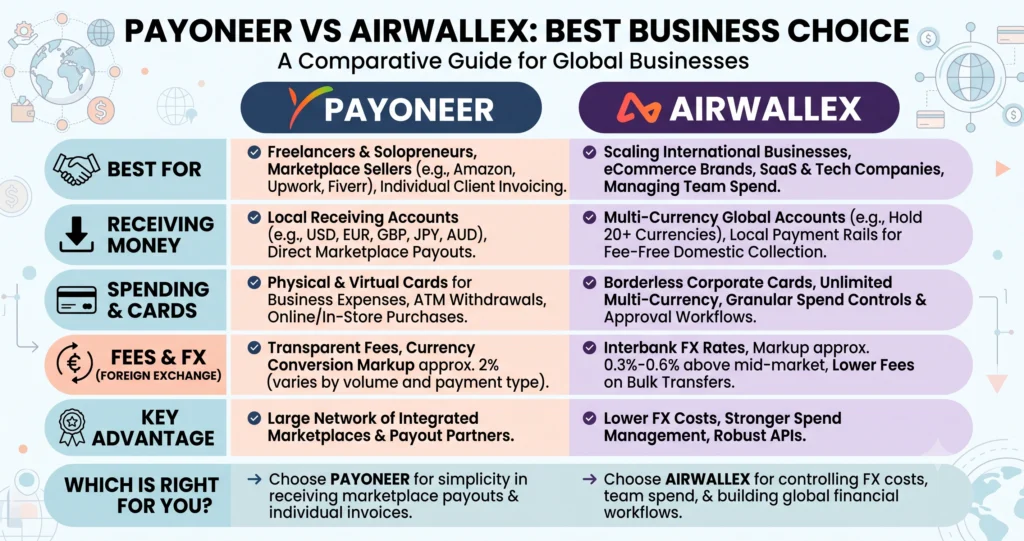
However, Airwallex may feel more advanced than Payoneer for beginners. It is better suited for businesses that want a scalable financial system instead of only a simple payout account.
Payoneer vs Airwallex Fees
Fees are one of the biggest differences between Payoneer vs Airwallex. Even small percentage differences can become expensive when your business handles large payments.
Payoneer’s pricing depends on how you receive, send, withdraw, or convert money. For example, Payoneer lists credit card payments at up to 3.99%, US ACH payments at 1%, and PayPal payments at up to 3.99% plus 0.49 USD or equivalent. It also lists moving funds between Payoneer balances at 0.50%.
Payoneer card fees can also apply. Its pricing page lists card transactions with currency conversion at up to 3.5%. In addition, ATM withdrawals may include a fixed withdrawal fee plus possible currency conversion costs.
Airwallex pricing is different. Its US pricing page lists domestic card payments at 2.8% + $0.30 and international cards at 4.30% + $0.30. It also supports 160+ local payment methods with a $0.30 fee plus payment method fees.
For FX and transfers, Airwallex lists 0.5% above interbank rates for major currencies and 1.0% for all others. It also lists fast local transfers to 120+ countries as free, while SWIFT transfers to 200+ countries cost $15–$25 per transfer.
Which Platform Is Cheaper?
There is no single winner for every business. Instead, the cheaper platform depends on your payment route.
Payoneer may be cheaper when you receive from another Payoneer user or from a supported marketplace with favorable payout terms. It can also be practical when you already use platforms that support Payoneer directly.
Airwallex may be cheaper for businesses that process many card payments, use local transfers, convert large currency balances, or need low-cost international payout routes. Its FX pricing can be more predictable for businesses that move money often.
As a result, the best approach is to calculate costs based on your real workflow. Do not compare only one headline fee. Instead, check receiving fees, FX markup, withdrawal fees, card fees, SWIFT fees, and support costs.
Payoneer vs Airwallex for Freelancers
Payoneer is usually better for freelancers who work through international platforms. Many freelancers need a quick way to receive money from clients or marketplaces and withdraw funds locally.
For example, a freelancer in Pakistan, India, the Philippines, or another international market may use Payoneer to receive payments from global clients. Payoneer can be easier because many freelance platforms already support it.
Airwallex can still work for agencies or professional service businesses. However, solo freelancers may not need its advanced tools, APIs, or team expense controls.
Best choice for freelancers: Payoneer
Payoneer vs Airwallex for Ecommerce Sellers
The right choice depends on where you sell.
Payoneer works well for sellers who receive marketplace payouts from platforms such as Amazon, eBay, or similar channels. It is simple, familiar, and widely used by online sellers.
Airwallex is better for ecommerce brands that run their own website and need payment acceptance, checkout tools, currency settlement, and expense cards. It also supports ecommerce plugins, no-code payment links, custom checkout, APIs, SDKs, and 3D Secure according to its pricing page.
Best choice for marketplace sellers: Payoneer
Best choice for independent ecommerce brands: Airwallex
Payoneer vs Airwallex for SaaS Companies
Airwallex is usually the stronger choice for SaaS companies. SaaS businesses often need recurring billing, automated payments, multi-currency pricing, and API connections.
Airwallex pricing lists subscription management for recurring customer payments and usage-based billing tools. These features can help SaaS companies manage monthly or usage-based revenue more smoothly.
Payoneer can still be useful for receiving payments or paying contractors. However, it is not as strong as Airwallex for embedded payment workflows.
Best choice for SaaS companies: Airwallex
Payoneer vs Airwallex for Global Teams
Airwallex has an advantage for growing teams because it offers corporate cards, spend controls, approvals, bill pay tools, and API-based automation. These features matter when a business has several employees, departments, or international vendors.
For example, a company can give virtual cards to team members, set spending rules, and track expenses from one dashboard. This reduces manual work and improves control.
Payoneer can also support business payments and cards. However, Airwallex feels more complete for finance teams that need advanced workflows.
Best choice for global teams: Airwallex
Customer Support and Reliability
Customer support matters because payment delays can hurt your business. If a payout is stuck or a transfer fails, you need quick help.
Payoneer promotes global business support and services in multiple languages. It also has wide country coverage, which can help freelancers and small sellers who operate internationally.
Airwallex has a more business-focused support model. Its US state licenses page lists customer support by phone for US customers from 07:00 to 17:00 PT, Monday through Friday.
Therefore, Payoneer may feel more beginner-friendly for smaller users. Meanwhile, Airwallex may suit businesses that prefer self-service tools, dashboards, and account management.
Pros and Cons of Payoneer
Pros
Easy to use for freelancers and online sellers.
Strong marketplace payout support.
Available in many countries and territories.
Supports 70 currencies.
Useful for receiving, withdrawing, and spending funds.
Cons
Fees can vary by country, currency, and payment method.
Card and ATM fees can add up.
Less advanced than Airwallex for APIs and automation.
Not always the cheapest option for large currency conversions.
Pros and Cons of Airwallex
Pros
Strong tools for growing businesses.
Competitive FX pricing for many business use cases.
Good for ecommerce, SaaS, agencies, and global teams.
Supports card acceptance, local payment methods, billing, and APIs.
Offers corporate cards and spend controls.
Cons
May feel complex for beginners.
Not always ideal for solo freelancers.
Some support options may depend on business hours and region.
SWIFT transfer fees can apply.
Wise Business as an Alternative
Wise Business is worth considering if your main goal is low-cost international transfers and transparent currency conversion. Wise says its US business account uses the mid-market exchange rate without markups and charges a one-time 31 USD setup fee.
Wise can be useful for businesses that want simple international payments, local account details, and clear fees. However, it may not replace Airwallex if you need advanced payment acceptance, corporate card controls, or deep API-based workflows.
In simple terms, Wise Business is strong for sending, receiving, and converting money. Payoneer is strong for marketplace payouts. Airwallex is strong for global business infrastructure.
How to Choose Between Payoneer and Airwallex
Follow these steps before opening an account.
1. List your main payment sources
First, check where your money comes from. If most of your income comes from marketplaces, Payoneer may be easier. However, if customers pay through your own website, Airwallex may offer stronger payment tools.
2. Check your main currencies
Next, list the currencies you receive and pay. Currency conversion fees can quietly reduce profit. Therefore, compare FX rates before choosing.
3. Review withdrawal and transfer routes
Look at how you move money to your local bank, suppliers, contractors, or employees. A platform with low receiving fees may still be expensive if withdrawal costs are high.
4. Compare card and team features
If you only need one card, Payoneer may be enough. However, if your team needs several cards, spending limits, and approval flows, Airwallex may be better.
5. Think about future growth
A freelancer may only need simple receiving today. Even so, an ecommerce brand or SaaS company may need APIs, billing, and automation later. Choose the platform that fits your next stage, not only your current stage.
Common Mistakes to Avoid
Do not choose a payment platform only because it has a famous name.
Do not ignore FX markups because they can become expensive over time.
Do not compare only card fees while ignoring withdrawals, SWIFT fees, and conversion charges.
Do not open an account before checking whether your country, business type, and platform are supported.
Do not assume fees are the same in every country. Always confirm the final price inside your account dashboard.
Final Verdict: Payoneer vs Airwallex
Payoneer vs Airwallex is not a simple winner-takes-all comparison. Each platform serves a different type of business.
Choose Payoneer if you are a freelancer, creator, affiliate marketer, or marketplace seller. It is simple, widely used, and useful for receiving money from global platforms.
Choose Airwallex if you run an ecommerce brand, SaaS company, agency, or international team. It offers stronger automation, APIs, payment acceptance, corporate cards, and global finance tools.
Choose Wise Business if you mainly want transparent international transfers and currency conversion using the mid-market rate.
Overall, the best platform is the one that matches your payment route, business size, currencies, and growth plans.
FAQ
Payoneer is better for freelancers, marketplace sellers, and small businesses that receive payouts from global platforms. Airwallex is better for businesses that need payment acceptance, APIs, automation, corporate cards, and international finance tools.
Airwallex can be cheaper for some businesses, especially those that convert currencies often or use local transfers. However, Payoneer may be cheaper for certain marketplace payouts or Payoneer-to-Payoneer payments. Always compare your real payment route.
Yes, many businesses can use both. For example, you can use Payoneer for marketplace payouts and Airwallex for website payments, supplier payouts, team cards, and expense management.
Yes, Payoneer is a practical choice for freelancers because it supports global receiving, marketplace payouts, and local withdrawals. It is especially useful when clients or platforms already support Payoneer.
Wise Business may be better for simple international transfers and transparent FX conversion. However, Payoneer is stronger for marketplace payouts, while Airwallex is stronger for ecommerce payments, APIs, corporate cards, and business automation.