

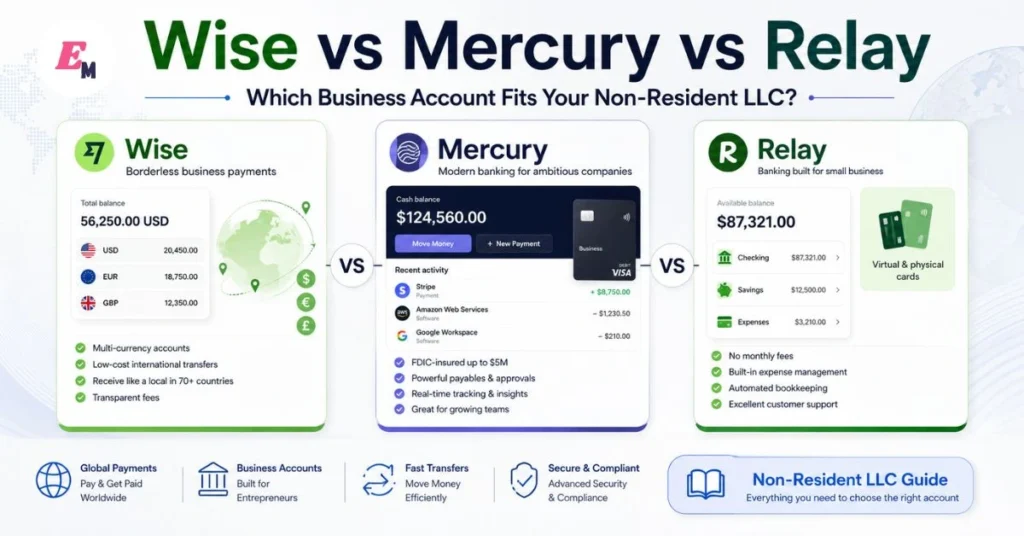
Wise vs Mercury vs Relay: Which Business Account Fits Your Non-Resident LLC?
There is no single “best bank” for every non-resident LLC. The right choice depends on how your business gets paid, which currencies you use, where you live, and how you manage cash.
For many LLC owners, Wise, Mercury, and Relay look similar at first. Each gives online access to business money. Each can help a US LLC receive or send payments. However, they solve different problems.
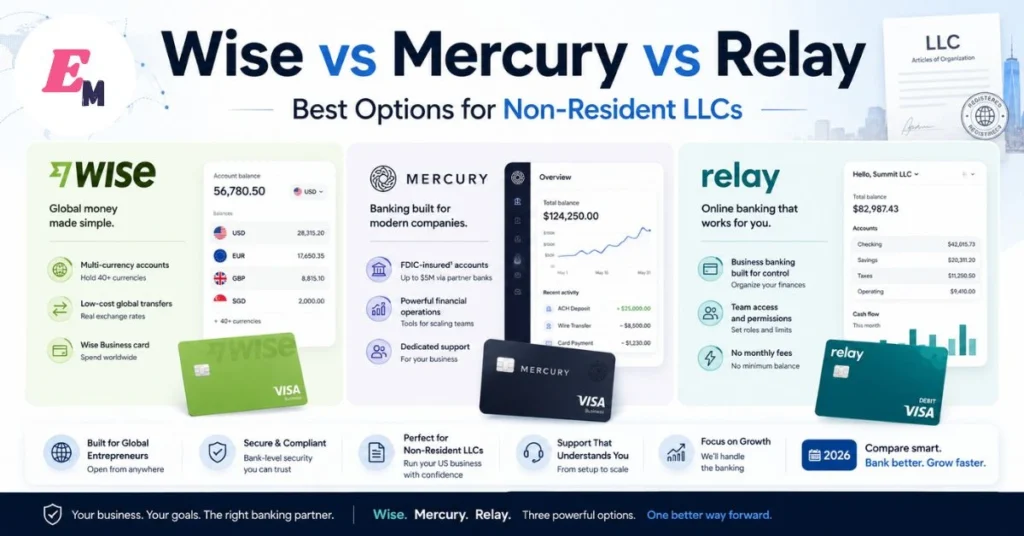
Mercury is strong for USD-first businesses. Wise Business is strong for multi-currency payments. Relay is strong for organizing cash into separate accounts and cards.
The mistake is choosing by brand name only. Instead, choose by your real workflow.
Quick Answer: Wise vs Mercury vs Relay
Wise, Mercury, and Relay are not traditional banks in the classic branch-based sense. Mercury says it is a fintech company, with banking services provided through partner banks such as Choice Financial Group and Column N.A. Relay also states that it is a financial technology company, not an FDIC-insured bank, with banking services provided by Thread Bank. Wise is authorised in the UK as an electronic money institution, not a bank.
Here is the simple version:
| Business Need | Best Fit | Why |
|---|---|---|
| You earn and spend mostly in USD | Mercury | Strong USD banking tools, free USD international wire option, polished startup-style dashboard |
| You bill clients in EUR, GBP, USD, or other currencies | Wise Business | Multi-currency balances, account details in many currencies, transparent conversion fees |
| You want separate accounts for taxes, payroll, suppliers, and expenses | Relay | Multiple checking accounts, multiple cards, and strong cash organization |
| Mercury rejected your country of residence | Relay or Wise | Mercury has a prohibited-country list that can block otherwise legitimate founders |
| You need a full US banking ecosystem | Mercury or Relay | Wise may not work everywhere a US bank-style account is expected |
Overall, Mercury fits USD operations. Wise fits international billing. Relay fits cash flow control.
Why “Best Bank for My LLC” Is the Wrong Question
Many non-resident founders ask, “What is the best bank for my LLC?”
That question sounds logical, but it usually leads to the wrong answer. Your LLC does not need the most famous provider. It needs the account that matches your payment routes.
For example, a software consultant paid only in USD has different needs from an agency paid in euros and pounds. Likewise, an e-commerce seller who needs separate accounts for taxes and suppliers has different needs from a solo freelancer who only wants one simple account.
The real question is:
Which account fits how my LLC receives, holds, converts, and sends money?
That question protects you from common problems, such as:
- Losing money on forced currency conversion
- Getting rejected because of your country of residence
- Choosing an account that does not support your payment processor
- Mixing tax, supplier, payroll, and operating money
- Opening too many accounts and creating compliance confusion
A business account is not only a place to hold money. It is part of your payment system.
Side-by-Side Comparison: Mercury, Wise Business, and Relay
| Feature | Mercury | Wise Business | Relay |
| Best for | USD-first startups and online businesses | Multi-currency invoices and global clients | Cash organization and budgeting |
| Monthly fee | Core checking and savings accounts are free | Fees vary by country and features | Starter plan has no monthly fee |
| Main currency strength | USD | Multi-currency | USD |
| Multi-currency holding | Limited; Mercury supports USD accounts | Strong; holds 40+ currencies | Limited compared with Wise |
| Receiving non-USD payments | Some accounts can receive non-USD wires, but funds convert to USD | Strong for receiving in several currencies | More USD-domestic focused |
| International payments | USD wires can be free; non-USD wires may have conversion fees | Strong international transfer system | Available, but not its strongest feature |
| Account structure | Good business dashboard | Good global money tools | Up to 20 checking accounts on most plans |
| Best case | USD invoices and SaaS spending | EU, UK, and global clients | Taxes, payroll, suppliers, and expense separation |
| Weak point | Country eligibility and USD-first setup | Not a full traditional US bank account | Less ideal for multi-currency businesses |
Mercury’s pricing page says customers can send USD international wires for free, although intermediary fees may still affect the recipient depending on processing method. Mercury also lists a 1% conversion fee for non-USD international wires.
Wise Business pricing shows transparent fees, no inflated mid-market exchange rate, and account details to receive in 22 currencies in the UK pricing example. Wise also says holding money is free and conversion fees start from 0.33%, although pricing depends on country and currency.
Relay says businesses can open up to 20 checking accounts on most plans and up to 50 on Scale, with account nicknames such as “Taxes,” “Payroll,” and “Operating.” Relay also promotes no hidden fees, no overdraft fees, and no minimum balances on its pricing page.
Real Case 1: Mercury for a USD-First LLC
Let’s call the first client Atlas.
Atlas owned a single-member LLC and sold software development services. Most clients were based in the United States. A few were in Europe, but they agreed to pay invoices in USD.
Atlas needed four things:
- Receive USD wires
- Pay SaaS subscriptions by card
- Connect banking to accounting software
- Keep operations simple
For this setup, Mercury made sense.
Mercury works well when the business lives mostly in dollars. The dashboard is clean, startup-friendly, and built for online companies. It also has strong payment and integration features for founders who operate in the US dollar system.
However, Mercury was not the right choice because it was “better” than Wise or Relay. It was the right choice because Atlas had a USD-first business.
Where Mercury Works Best
Mercury is a strong option when:
- Your clients pay in USD
- Your contractors or vendors accept USD
- You want a polished online business account
- You need cards for software, ads, and subscriptions
- Your country of residence is accepted
- You do not need to hold EUR, GBP, or other currencies
This matters because Mercury supports USD accounts. Its support page says non-USD incoming wires, where supported, are automatically converted into USD before reaching the account. Mercury cannot hold or maintain non-USD balances.
Therefore, Mercury is not a true multi-currency account like Wise. It can handle some international activity, but its core strength remains USD operations.
Where Mercury Can Break
Mercury can fail before you even start if your country of residence is not supported. Mercury keeps a prohibited-country list for founders it cannot currently support. The official list has included countries such as Pakistan, Nigeria, Bangladesh, Vietnam, Ukraine, and others, so founders must check the current list before applying.
This is a serious issue for non-resident LLC owners. A clean LLC, valid EIN, and professional website may not be enough if the founder’s residence is restricted.
Mercury also may not be ideal if:
- You bill European clients in EUR
- You need local IBAN-style receiving details
- You want to hold multiple currencies
- Your business has unclear payment flows
- Your application uses weak or inconsistent documentation
In short, Mercury is excellent for the right USD-heavy business. However, it is not the safest choice for every foreign-owned LLC.
Real Case 2: Wise Business for a Multi-Currency LLC
Now let’s look at Meridian.
Meridian ran a design agency with clients in Germany, the UK, Canada, and the United States. Some clients paid in euros. Others paid in pounds. A few paid in dollars.
At first, Meridian tried to use a USD-only setup. That created a problem. Every non-USD payment was converted into dollars too early. As a result, the agency lost money on exchange rates and extra fees.
Wise Business solved the main pain point.
With Wise, Meridian could receive money in several currencies, hold balances, and convert only when needed. This made invoices easier for clients and reduced unnecessary currency losses.
Where Wise Business Works Best
Wise Business is a strong fit when:
- You invoice clients in EUR, GBP, USD, CAD, AUD, or other currencies
- You want local-style account details where available
- You need to hold multiple currency balances
- You pay contractors in different countries
- You care about transparent exchange rates
- You do not want hidden bank FX margins
Wise says users can hold over 40 currencies, and its business pricing page shows account details for receiving in 22 currencies in the UK example. Wise also states that it does not inflate the mid-market exchange rate.
That is why Wise often fits agencies, freelancers, consultants, remote teams, and service businesses with global clients.
Where Wise Business Can Fall Short
Wise Business is not the same as having a traditional US business bank account.
That matters because some platforms, processors, lenders, or payroll tools may expect a more standard US banking relationship. In those cases, Wise may not be accepted or may create extra friction.
Wise may also charge fees depending on the country, currency, and payment method. For example, Wise’s UK business pricing page lists a setup fee for full business features and fixed fees for some SWIFT or wire receipts.
So, Wise is not “free international banking.” It is better described as a transparent multi-currency money account.
Choose Wise when currency is your main problem. Do not choose it only because it looks easier to open.
Real Case 3: Relay for Cash Flow Organization
The third client, Vertex, ran a small e-commerce business.
The company had regular money coming in, but cash management was messy. Supplier payments, ad spend, taxes, owner draws, and operating expenses all sat in one balance.
That made the business feel profitable when it was not. Some money looked available, but it was already reserved for taxes or inventory.
Relay fit this case because the problem was not currency. The problem was organization.
Where Relay Works Best
Relay is useful when you want to separate money into clear buckets.
For example, an LLC owner can create accounts such as:
- Operating
- Taxes
- Payroll
- Supplier payments
- Emergency reserve
- Owner pay
- Advertising budget
Relay’s help center says most plans allow up to 20 checking accounts per business, while the Scale plan allows up to 50. It also allows users to nickname accounts and manage access by team member.
This makes Relay attractive for Profit First-style budgeting, small agencies, e-commerce businesses, bookkeeping-heavy businesses, and founders who need better financial discipline.
Where Relay Can Fall Short
Relay is not the strongest choice for multi-currency operations.
It is mainly useful for USD-focused businesses that need structure. If your clients pay in euros, pounds, or several other currencies, Wise may be a better primary account.
Relay also may not have the same startup-focused ecosystem as Mercury. For example, some founders prefer Mercury’s interface, integrations, and investor-friendly feel. However, Relay can still be a serious option if Mercury rejects you or if your main need is cash separation.
In simple terms, Relay is not a consolation prize. It solves a different problem.
Why You Should Not Open All Three Without a Reason
After comparing Wise, Mercury, and Relay, some founders think they should open all three.
That sounds safe, but it can create more problems.
Each account is a compliance relationship. Every provider needs to understand your business model, customer base, payment flow, and ownership structure. If money moves between several fintech accounts without a clear reason, it may trigger extra questions.
More accounts also mean more bookkeeping work. You must track balances, transfers, fees, and statements. For a small LLC, that can become messy fast.
A better approach is:
- Choose one primary account that fits your main operation.
- Use a second account only when there is a clear business reason.
- Keep documents, invoices, contracts, and payment records organized.
- Avoid moving money in ways you cannot explain.
- Review tax and reporting duties separately from banking.
The goal is not to collect accounts. The goal is to build a payment setup that works smoothly.
Compliance and Tax Reminder for Non-Resident LLC Owners
Your business account does not remove your tax responsibilities.
A US LLC may still have filing, bookkeeping, reporting, and tax obligations depending on its structure, owners, activities, and income source. In addition, FBAR rules may apply in some cases involving foreign financial accounts.
FinCEN says a United States person with a financial interest in, or signature authority over, foreign financial accounts must file an FBAR if the aggregate value exceeds $10,000 at any time during the calendar year. The IRS also explains that FBAR is reported through FinCEN Form 114, not as part of a standard tax return.
This article is not tax or legal advice. However, it is important to understand one thing clearly: the account moves money, but it does not decide your tax position.
Speak with a qualified tax professional if your LLC has foreign owners, foreign accounts, US-source income, employees, inventory, or marketplace sales.
Checklist: Choose the Right Account for Your LLC
Use this checklist before applying.
Choose Mercury if:
- Your LLC earns mostly in USD
- Your clients can pay by ACH, wire, or US payment methods
- You want a polished fintech dashboard
- Your residence country is accepted
- You do not need to hold foreign currencies
- You want strong US-focused startup banking tools
Choose Wise Business if:
- You invoice clients in more than one currency
- You need EUR, GBP, USD, or other account details
- You want to hold balances before converting
- You pay international contractors
- You want transparent FX fees
- You do not require a full traditional US bank account
Choose Relay if:
- You want separate accounts for taxes, payroll, and expenses
- You run an e-commerce, service, or agency business
- You prefer budgeting with real account separation
- You need multiple debit cards
- Mercury is not available to you
- Your business is mostly USD-based
Common Mistakes to Avoid
Many non-resident LLC owners make the same mistakes when choosing between Wise, Mercury, and Relay.
Mistake 1: Applying Before Checking Country Eligibility
This is especially important with Mercury. If your country is not supported, applying again with the same information will not fix the issue.
Mistake 2: Choosing a USD Account for EUR Clients
If your clients are in Europe and want to pay in euros, a USD-only setup can create avoidable conversion costs.
Mistake 3: Opening Too Many Accounts
More accounts can mean more compliance reviews and more bookkeeping work. Use multiple accounts only when each has a clear purpose.
Mistake 4: Ignoring Payment Processor Requirements
Before choosing an account, check whether your payment processor, marketplace, or invoicing tool accepts that account type.
Mistake 5: Treating Banking as Tax Planning
A Mercury, Wise, or Relay account does not decide your LLC’s tax treatment. Banking and tax compliance are separate topics.
Expert Tips for a Stronger Application
A clean application can reduce delays and confusion.
Before applying, prepare:
- LLC formation document
- EIN confirmation letter
- Operating agreement
- Passport or government ID
- Real business website or landing page
- Clear business description
- Expected payment countries and currencies
- Invoices, contracts, or proof of activity if available
- Residential address and business address details
Also, keep your story consistent. If your website says you sell design services, your application should not say you trade electronics. If your invoices are in euros, do not describe the business as USD-only.
Consistency builds trust.
Final Verdict: Which One Should You Choose?
Choose Mercury if your LLC is USD-first and your residence country is accepted. It works well for startups, software businesses, consultants, and online companies that mostly receive and spend dollars.
Choose Wise Business if your LLC earns in several currencies. It is especially useful for agencies, freelancers, and global service providers that bill clients in EUR, GBP, USD, or other currencies.
Choose Relay if your LLC needs better cash organization. It is a strong fit for e-commerce sellers, small agencies, and founders who want separate accounts for taxes, payroll, suppliers, and operations.
There is no universal winner in the Wise vs Mercury vs Relay comparison. The best account is the one that matches your real payment flow.
FAQs About Wise vs Mercury vs Relay
Mercury can be better if your LLC earns and spends mostly in USD. However, Wise is usually better if you receive payments in EUR, GBP, USD, or other currencies and want to hold balances before converting.
Wise Business is not a traditional bank account. Wise is authorised as an electronic money institution in the UK, and services vary by country. It is useful for international payments, but it may not replace a full US banking relationship for every LLC.
Relay can be useful for LLC owners who want to organize money into separate checking accounts. It is especially helpful for taxes, payroll, suppliers, and operating expenses. However, it is less focused on multi-currency payments than Wise.
You can apply where eligible, but opening all three without a clear reason can create compliance and bookkeeping problems. It is usually better to choose one primary account and add another only when your business needs it.
Wise Business is often the better fit for European clients because it supports multi-currency receiving and account details in several currencies. Mercury and Relay are stronger for USD-focused operations.